Blessed are the peacemakers

A frail old man went to live with his son, daughter-in-law, and four-year-old grandson. The old man’s hands trembled, his eyesight was blurred, and his step faltered. The family ate together at the table. But the elderly grandfather’s shaky hands and failing sight made eating an adventure. Food fell off his spoon onto the floor. When he grasped the glass, milk spilled onto the tablecloth.
It didn’t take long for the son and daughter-in-law to become irritated with the mess. “We must do something,” the son decided. “I’ve had enough of his spilled milk, noisy eating, and food on the floor.” So, the husband and wife set a small table in the corner. There, Grandfather ate alone while the rest of the family enjoyed their dinners together.
Since Grandfather had broken a dish or two, his food was served in a wooden bowl. The only words the couple had for him were sharp admonitions when he dropped a piece of silverware, or spilled his food.
The four-year-old watched it all in silence. One evening before supper, the father noticed his son sitting on the floor, playing with a piece of wood. He asked his son sweetly, “What are you making?” Brightly, the boy responded, “Oh Daddy, I am making a bowl for you and Mama to eat your food in, when you get old.” The four-year-old smiled and went back to work.
The next night, Grandfather joined them at the family table.
Thank you, young man. This little boy shines his light, as a peacemaker.
Peacemakers always find a place at the table for anyone left out. Find a place for anyone on the outside. Find a place for anyone excluded.
Peacemakers include.
Taking Mother Teresa to heart, “One of the reasons we don’t have peace in this world is that we have forgotten that we belong to one another.”
But in a world that too easily feels upside down, we too easily forget.
I once was blind, but now I see.
This is the familiar text from the Gospel of John. (It is an avowal made famous by John Newton, former slave trader, and author of the world’s most recognized song: Amazing Grace.)
Whenever I preach this story, I tell the congregation that this is not a case study, or cerebral exercise, or illustration. At some point, this is personal. “I am the man in that gospel story,” I tell the congregation, “And we need to decide whether or not we are playing church.
Either we believe in real transformation or we do not.
Either we believe in grace, or we do not.
Either we believe in inclusion and compassion, or we do not.
Either we believe in bringing people to the table, or we do not.
Either we believe in hope, or we do not.
This transformation cannot be orchestrated or coerced or predicated on shame. It can however, be embraced, and celebrated, and shared.”
“Well, nobody else can live the life you live,” My hero Mr. Rogers reminds us. “And even though no human being is perfect, we always have the chance to bring what’s unique about us to live in a redeeming way.”
Of course it is always easier to believe this affirmation about others, than it is to believe it about ourselves. And that light inside does dim from time to time. And if we’re honest we know how easy it is to live small or to be diminished; by shame or exhaustion or discouragement. And we are no longer dispensers of grace and light. In other words, we live with armor.
This we know, to be a peacemaker, you have to be willing to serve others. To value their dignity above your preferences. To prioritize reconciliation over winning.
God cares about justice. God cares about every person made in His image. God’s kingdom is multicultural.
Asked about what sometimes looks like a distinct lack of compassion in human society, the Dalai Lama issued this invitation: “Perhaps we just pay less attention to compassion and caring; we reinforce it less. Whereas in some sense, we fully embrace hostility and anger as an emotional state, fueling and reinforcing it. If we were to give the same amount of energy, attention, and reinforcement to compassion and caring, they would definitely be stronger.”
Yes. Either there is real transformation, or there is not. The power to surrender the constraint that comes with wooden bowls and small tables in the corner.
“Think and imagine a world when love is the way,” Bishop Michael Curry (presiding Bishop of the Episcopal Church).
And yet. There are cracks in our psyche. In our relationships. In our world. We try to hide or run from them or keep them contained, or find a wooden bowl in order to not be embarrassed. Perhaps you can relate.
Seeing only the cracks, our blindness may not be complete darkness, but scotoma (selective blindness). Because vulnerability unnerves me so, I often prefer to live with my blindness. (Of course, it’s always for a good reason. After all, it seems to serve me well.) Regardless, it is a way of not-seeing, and in the end, a way of not-living. And in our increasingly polarized world, this blindness prevents us from being present. Or aware. Or compassionate. Whether it is to those close to me, or to injustice, or to joy, or to passion. When we are blind, we hide behind self-righteousness, narrow-mindedness, an unfair life, self-doubt, and fear.
Here’s what I find heartening about both the Gospel story and the story of the wooden bowl. The transformation comes, when we recognize that sight—this new way To Be in the world—is a Gift. It doesn’t happen because we try harder. Or have more faith.
What difference does this make?
If we give up our blindness, we accept our vulnerability and embrace responsibility. Because Grace gives us sight. And sight connects us. (I love the greeting in the movie Avatar, “I see you.” I acknowledge you.) And this kind of love has the power to change the world.
I don’t have three steps to compassionate living. However, here’s the deal; if we are open to it, grace—the power of love—changes our life. And that change spills to everyone around us. Even if we can’t explain it.
“All I know,” said the man, “is that once I was blind and now I see.”
I just finished a weekend retreat at Mercy Center in Auburn, CA. The energy in the group and the room was life-giving. And for that I am very grateful.
And yes, as a Seattle Seahawk fan, I am smiling big.
Quotes for your week…
“We live in a world in which we need to share responsibility. It’s easy to say, ‘It’s not my child, not my community, not my world, not my problem.’ Then there are those who see the need and respond. I consider those people my heroes.” Mr. Rogers
Thank you for your patience as technology issues still plague us. My email address tdh@terryhershey.com is up and running.
I am so very grateful that you are a part of Sabbath Moment. And grateful for the support that makes it possible. Please, pass Sabbath Moment on to friends. And invite them to join us.
BULLETIN BOARD
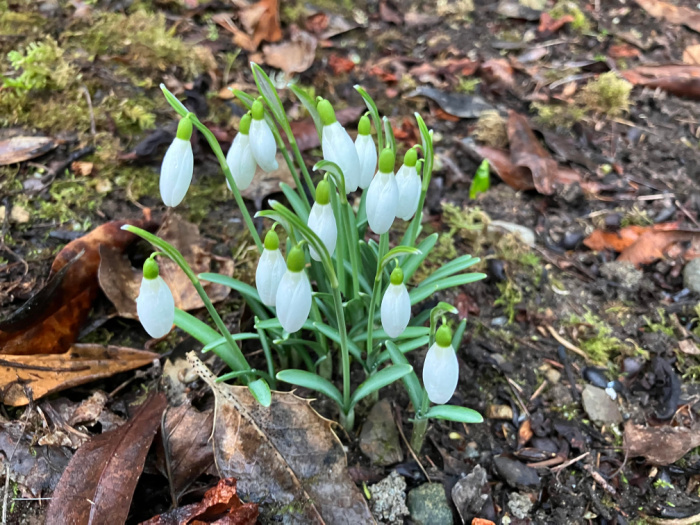
Today’s Photo Credit: “Dear Terry, A few new photos around Paso Robles” Debbie and Rick Minton… Thank you Debbie and Rick… Thank you to all, I love your photos… please, keep sending them… send to tdhersheyster@gmail.com
Yes, your gift makes a difference… Donation = Love…
Help make Sabbath Moment possible. I write SM because I want to live with a soft heart; to create a place for sanctuary, empathy, inclusion, compassion and kindness… a space where we are refueled to make a difference. SM remains free.
(Address by check: PO Box 65336, Port Ludlow, WA 98365)
POEMS AND PRAYERS
Circle me O God
Keep hope within
Despair without.
Circle me O God
Keep peace within
Keep turmoil out.
Circle me O God
Keep calm within
Keep storms without.
Circle me O God
Keep strength within
Keep distress out.
Celtic Caim Prayer
When the world feels hopeless and heartless,
take a moment to look around.
There are beautiful humans everywhere,
often hiding in plain sight in cabs,
on buses, in cafes, on trains, in libraries,
on park benches, in laundromats, on subways.
They may not be rich or well-educated.
They may be broken and hurting themselves.
They may not have much to offer
in terms of worldly goods.
But they are the comforters, encouragers, sharers,
teachers, servers, healers, mentors, connecters,
helpers, and counselors who keep
the random hurting humans,
the weary and the lost,
the invisible sufferers who walk among us every day,
going just long enough
to find their hope and strength again.
It doesn’t take a degree or wealth
or a grand gesture to make a
difference in this world.
It just takes a human who cares.
L.R. Knost
Music for the Soul…
New–
Nelson — Larry Murante