Daily Dose (Apr 29 – May 2)
TUESDAY APRIL 29 —
In Matthew’s Gospel we read the story. “The crowd rebuked the blind men sitting by the road, telling them to be silent, but they cried out all the more, ‘Lord have mercy on us, Son of David.’”
Yes indeed. It resonates. Times when we cry out for the healing balm of God’s mercy. This week, let us sit, and allow that to percolate. A balm that is healing and replenishing and sustaining for both hope and courage.
And to know; it is okay to cry out.
True, there is a part of us that wonders (as we do with many kinds of prayer), “Am I doing it correctly?”
And I smile big. We assume way too often that our connection to God is a test to pass. And we miss the fact that our cry, is in fact, music to heaven’s ears. Music that lifts our vulnerability and recognizes the healing power of grace and mercy.
Bob works as a pediatric nurse with terminally ill children. One of his “patients,” is a little girl named Emily. Emily loved playing with Bob when he visited her room. She felt safe and they become fast friends. Occasionally, Emily would talk about the time when “Chucky Lee” was “going to come.” Bob assumed she was speaking of a friend, or family member. So, one day he asked her.
Emily told Bob, “Chucky Lee comes to see me sometimes.” And then paused and added, “Chucky Lee is death. Someday Chucky Lee will come and take me away.”
Bob knew that Emily needed to personify death into a character she could understand. It made perfect sense.
“Are you frightened?” he asked.
“Yes, very much. Mostly he comes at night.”
Bob was moved by her clarity and innocence. And he wanted to protect her, to shield her from such sorrow. “At night, when you feel Chucky Lee coming, is there anything you can do to feel better?”
“Oh, yes,” Emily replied brightly, “You have to sing Jingle Bells and other love songs!”
After that Bob asked specifically about her nights.
“Well,” she told him, using a conspiratorial whisper, “Last night, I had to sing Jingle Bells three times, very, very loud.”
Indeed Emily. Very, very loud…
We can all learn from Emily. Let’s call it the music of transformation.
Although, to be honest, I’d rather a life exempt from the visits of Chucky Lee. Whether it is heartache, fragility, vulnerability, breakability, weakness or disillusionment. Each of them, in their own way, a small death.
I too easily become cynical. And I will admit that some part of me doesn’t want to believe stories that have peaceful endings.
But in my heart, I know that only light can push the darkness away.
Light. And very, very loud renditions of love songs. And cries for mercy.
We can do that. Cries for mercy, and paying attention to the cries of those near us. Because yes: we are the voices of mercy.
And we make a difference. In our humility, we can make choices to be transformed. So, this week, let us pay it forward, singing jingle bells with fellow travelers, who need a hand to hold.
Note: Chucky Lee story adapted from Wayne Muller’s book, How then shall we live?
WEDNESDAY APRIL 30 —
I am remembering a touching conversation with a friend. As paramedics worked over the body of a young man dying from an overdose, my friend held her 21-year-old friend tightly, as he sobbed in her arms, hyperventilating. She didn’t know quite what to say, but whispered over and over, “breathe with me, breathe in the spirit, and breathe out the junk.” She told me, “I cleaned up the blood-stained carpet left by the paramedics. It was my prayer of servitude, I guess. It is an unusual feeling, cleaning up the blood of someone who is dying, but there is a profound sense of devotion to what is sacred here. It’s not just about the bloody and messy, but about the fragility of life, and how life doesn’t unfold neatly and how I have so much to learn in trusting that truth.”
Yes: trusting that truth… it is in our vulnerability and humility that we find the strength and the power to take care of one another. To walk each other home.
And here’s the deal: Sometimes we need to hold someone tight, even if we don’t know what to say. A hug that says, “You matter.”
Sometimes we need to let ourselves be held tightly, even if we don’t believe the words of hope being whispered in our ear.
Sometimes we need to walk the dog, fill the birdfeeders, talk with a friend, or reach out to someone who feels completely undone by the often unnerving uncertainties (and often insecurities) of our time.
Sometimes we must be very still, for an afternoon, and use our stillness as a prayer, a silent song—a cry for mercy—to the heavens.
And sometimes, we need to sing Jingle Bells and other love songs very, very loud.
And this I know: this is an impact that spills to the world…
We assume way too often that our connection to God is a test to pass. And we miss the fact that our cry, is in fact, music to heaven’s ears. Music that lifts our vulnerability and recognizes the healing power of grace and mercy.
Bono’s affirmation, “Music can change the world, because it can change people.”
Although, I am smiling, knowing that music doesn’t always have its intended result. A good many years ago, Zach and I are tooling down a Vashon country road, Matisyahu’s One Day blasting (what is heartfelt music, if not loud?), and me singing along with unabashed gusto.
“Dad,” Zach says, “Shhhh. You know these feel-good songs, the ones where you can almost taste the sadness? Well, the way I listen to them is to become like an Indian doing meditation. And Dad, when you sing along, you mess up my mantra.”
Ohhhh. Okay. Thank you, son. I know I can’t carry a tune. I just never knew I could mess up someone’s manta.
I do know what he means though. About the almost taste the sadness part. Music has a power that enables it to find its way into the crevices of our soul.
You see; music of hope, music as cries for mercy, is transformative.
So, where do we find and spill the music of healing and redemption and transformation?
Music that gives hope to people around us.
Small headlines, even about big quandaries, more often than not, escape our notice. I wish it were not so. But we live in a world where bombardment (onslaught) wins our attention.
But let take this to heart today: it is in our vulnerability and humility that we find the strength and the power to take care of one another.
And just because our music of kindness and mercy and compassion—and yes, courage and resilience—is under the radar (or not even sung in tune), doesn’t mean it doesn’t change our world.
THURSDAY MAY 1 —
There is a well-known story concerning a Rabbi who came across the prophet Elijah, and asked him: “Tell me—when will the Messiah come?”
Elijah replied, “Go and ask him yourself.”
“Where is he?” asked the Rabbi.
“He’s sitting at the gates of the city,” said Elijah.
“But how will I know which one is he?”
The Prophet replied, “He is sitting among the poor, covered with wounds. The others unbind all their wounds at the same time and bind them up again, but he unbinds only one at a time and binds them up again, saying to himself, ‘Perhaps I shall be needed; if so, I must always be ready so as not to delay for a moment.’”
In his book The Wounded Healer, Henri Nouwen adds, “What I find impressive in this story are these two things: first, the faithful tending of one’s own woundedness and second, the willingness to move to the aid of other people and to make the fruits of our own woundedness available to others.”
I’ve known about the story of the wounded healer for many years. I first read it in seminary. I understood in cerebrally. Now, I get it, in my gut. I just don’t like those wounded (flawed, broken) parts of me. But I do know what it is to be wounded. Though I do my very best to hide it. I see nothing good there.
But what if? What if brokenness is not a “fixable problem,” but an opportunity for grace and love and ministry—in a world that is crying out for mercy?
Many of us live under the illusion that some “expert” has created a life to die for, to be emulated. If that’s the case, knock yourself out, but just remember that there’s no one to complain to when you find out that, in the end, you—the flawed and broken you—can be a pretty trustworthy guide on this expedition we call life. Nouwen writes, “Nobody escapes being wounded. We all are wounded people, whether physically, emotionally, mentally, or spiritually. The main question is not ‘How can we hide our wounds?’ so we don’t have to be embarrassed, but ‘How can we put our woundedness in the service of others?'”
When we do, we are Tikkun Olam, repairers of the world.
“He (Pope Francis) often used the image of the Church as a ‘field hospital’ after a battle in which many were wounded; a Church determined to take care of the problems of people and the great anxieties that tear the contemporary world apart; a Church capable of bending down to every person, regardless of their beliefs or condition, and healing their wounds.” Cardinal Re said in the funeral homily.
Yes, and Amen. Francis, a voice of mercy, for the wounded and the marginalized—inviting the compassionate treatment of those in need (even and especially when it’s within one’s power to harm or “punish” them).
And this I know my friends: We live in an emotionally and spiritually de-hydrated world, thirsty for the sustaining balm of mercy—as repairers of the world.
Here’s the deal (and good news): We are all wounded healers (where our wounds cease to be a source of shame and become a source of healing). No, this is not a strategy. This is a fact. It spills from those parts of our life that have been broken open, from those parts of us flawed and imperfect.
So. What if this is not about accepting imperfection as some kind of divine teaching moment?
What if the gift is in the inimitability of our humanity?
When we embrace what is already inside, we live from the power of sufficiency.
FRIDAY MAY 2 —
Some days we wake up in a world that is not a friend of grace and mercy. At least, it doesn’t feel so. And the news puts a spotlight on what we do know to be true, we live in very unpredictable and broken world.
In the conversations I have with people from different parts of the country (and world), I know that most have been tainted with a kind of bafflement. (Some more than others.) Wondering, “What’s next?”
And it hurts my heart when it feels like insecurity and pain win.
A few years ago, during the pandemic, talking with my friend Phil Cushman in the grocery, we shook our heads about our world’s fragile nature, as if to say, “Where do we find sanity and sanctuary? And where do find hope?”
“It helps when I distinguish between big world and small world,” he said to me.
With that, a light bulb came on. You see, with big world, news is in your face and stoked with anger. And often, cruelty. No wonder we feel as if our control is demoted.
And we ask, how can I ever make a difference in a broken world?
Well that’s just it, we do make a difference in the small world.
The small world is the place where we stand. Today.
Where we care and where we give a damn. And hug and give and try and love and fall down and get up and repent and cry and embrace and challenge and reconcile and heal. Where we stand up, to make a difference with mercy and kindness.
Jeffrey Rubin tells the story about a young man who found a wallet on the street. It belonged to a city police officer. He found the precinct and returned the wallet that he found.
The detective was grateful and surprised. “Thank you,” he said to the young man. “Here’s forty dollars.”
The young man replied, “Thanks, but if I wanted the money, I would have kept the wallet.”
Makes me smile big. Yes. Making a difference in the small world with compassion free of ulterior motive and straight from the heart. The path we walk (the choices we make), is not arbitrary, or because we mentally assent to a certain creed. It is guided by and fueled by an identity that is grounded in and spills from sufficiency, and not scarcity.
Sufficiency is that place where Grace and Mercy are received and given freely.
Sufficiency where we remember Jesus’ words to each of us, “You are the light of the world.” He didn’t ask us to make the light. Just shine it.
When I live from scarcity, I’ve lost my mooring. I’m driven by “not enough.” I clutch, and I blame.
When I live from sufficiency, I am not compensating for what is missing, the world does not make me hate, I trust my heart, and any assumed scarcity (of kindness and compassion and mercy) does not get to say how the story ends.
On Monday, Rev. William Barber II (with two others), was arrested while praying in the U.S. Capitol Rotunda. Their prayer? “Against the conspiracy of cruelty, we plead the power of your mercy.”
After the death of Pope Francis Rev. Barber said that we must carry on the Pope’s mission to the marginalized. “We must now say, ‘I am Pope Francis,’” he said.
“Okay, count me in,” I say out loud as I read the comment. And then, “But how is that even possible?” (Let’s just say that skepticism and cynicism raise their irksome heads rather predictably.)
Then, I close my eyes, and take a deep breath.
And I take to heart the invitation: I can be a voice of mercy.
What does mercy look like?
How can I choose to heal, instead of choosing to hurt?
How can I spill grace to those around me, instead of disregard or neglect?
How can I make room for transformation and growth, instead of numbing and detachment?
Mercy is the fruit of compassion in a world where inhumanity and heartlessness is real. Mercy is any compassionate gift given to someone who is suffering.
I write this on May Day, which set a record for being the hottest May Day in England’s history. That’s something to write home about. And a good day to look for a very large shade tree.
I’m staying in an Airbnb cottage on a property. The history of the house, cottage and land goes back many, many years. The history of the land here, well known for sheep. And this cottage was the “shepherd’s cottage”. That makes me smile big.
Prayer for our week…
Risk
To laugh, is to risk appearing the fool.
To weep, is to risk appearing sentimental.
To give without regard for reward, is to risk misunderstanding.
To reach out to others, is to risk involvement.
To seek justice, is to risk reprisal.
To open your heart, is to risk vulnerability.
To expose feelings, is to risk exposing your true self.
To place your dreams before a crowd, is to risk their loss.
To love, is to risk not being loved in return.
To live, is to risk dying.
To hope, is to risk despair.
To try, is to risk failure.
But risks must be taken,
because the greatest hazard in life is to do nothing.
The person who risks nothing,
does nothing, has nothing, and is nothing.
They may avoid suffering and sorrow,
but they cannot learn, feel, change, grow, love, live.
Chained by their certitudes, they are a slave,
they forfeited their freedom.
Only the person who risks can be free.
Leo F. Buscaglia (with adaptations)
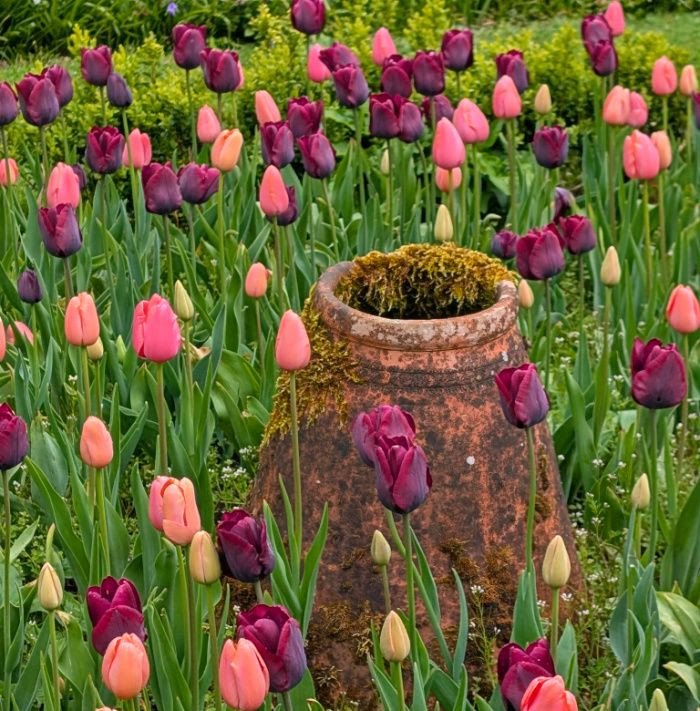
Photo… I’m sipping coffee this morning from a cup that says “I garden, therefore I am”, and I am so grateful to have moments during this month when the garden has replenished my heart and soul. It is tulip season hear in the Cotswolds…