Daily Dose (January 6 – 9)
TUESDAY JANUARY 6 — A pious man heard God. “Tomorrow night I’m going to visit your home,” the voice told him.
The man pushed aside his predictable hesitation, and rolled the dice in favor of belief. After all, it’s not often you get a personal invitation from the Creator.
Regardless of your religious inclinations, this is quite the occasion. And anyone who receives such an opportunity has one thought, “I’d better tidy up.” I’m just guessing here, but you probably don’t want God showing up to a cluttered house.
Early the next morning the man set out cleaning, scrubbing and gussying up.
There’s an ill-fated knock at the door. Why is it that we are interrupted at the most inconvenient times?
It is a long-time friend thinking that tonight would be a great night for beers and a football game. “I’d love to, but we’re together next week, let me focus on what I have here for a little bit.”
Not long after, there is another knock. The man’s neighbor wonders if he has a moment to talk about the back pasture that they share. The neighbor is not at all a likable fellow, a bit tedious and full of himself.
And not long after that, the man’s son, now grown and on his own, part reflection of his parents, part finding his own way, a bit fragile and on this night needing some counsel, or more likely, a sounding board.
The man’s response the same to each, “Can we take care of this another time? I’m expecting a very important guest.”
Each visit takes its toll. With so little time and all.
Evening approaches. Candles are lit. Wine is poured. The good stuff.
Nothing. One hour, two, three. Finally, he yells, “Where are you? You said you would visit me. You promised.”
And God speaks to him in a gentle voice. “I did visit you. I was in your friend. I was in your neighbor. I was in your son. And each time, you were not able to see.”
I have written before about scotoma, which can be translated, “selective blindness”. In other words, we see what we want to see. And because vulnerability—and the fear of being unworthy (whether feeling insufficient or blemished) unnerves me so, I often prefer to live with my blindness and hope for the best. (Of course, it’s always for a good reason. After all, it seems to serve me well.)
Bottom line, this is a choice. We choose.
And in the end, our way of not-seeing (a way of not-choosing) is a way of not-living. But here’s the deal: in our increasingly polarized world, this blindness prevents us from being present. Or aware. Or compassionate. Whether it is to those close to me, or to injustice, or to joy, or to passion. When we are blind, we hide behind self-righteousness, narrow-mindedness, an unfair life, self-doubt, and fear.
However. This story is not about fostering regret.
This story is an invitation.
Yes.
An invitation to celebrate.
To celebrate that at the very center or core of every encounter is an interaction with the sacred.
With the divine.
With God.
And to remember, that where there is darkness, we can we sow light.
Because of a belief system? No. Because we can choose. And let us remember: We are not at the mercy of what we hide behind—whether it is expectations, assumptions, labels, intolerance, bias, fear or power.
This is about the choices we make, to determine the path forward.
“Between stimulus and response there is a space. In that space is our power to choose our response. In our response lies our growth and our freedom.” Viktor E. Frankl
A blessed Feast of the Epiphany to all. Or, to some, the day after the twelfth day of Christmas. So, for many, a time to take down the Christmas tree. For others, like our house, we don’t mind keeping it up for a while, say, until we get closer to Lent.
And technology issues still plague us, as we moved our website to a new domain. Sadly, it has affected our email. tdh@terryhershey.com is still being adapted and reset, and my deep apologies to all who emailed me and had it returned. For the next wee bit, email me at tdhersheyster@gmail.com and I will respond. The website is up and running, including the ecourses and the bookstore.
WEDNESDAY JANUARY 7 — John Lewis is one of my heroes. He made us better people.
I like Andrew Young’s take. “(He) didn’t convince you by his arguments. He convinced you by his life… He believed what we talk about, and he lived it every day of his life. And he didn’t have a violent streak in his body. And he was always forgiving, always loving, always understanding. And he never made you feel guilty. But he made you feel responsible.”
Growing up, we loved to talk about conversion in our church. Mostly it meant punching my ticket for eternity (staying out of hell). And adherence to a belief system (even if I couldn’t explain it). Here’s what’s interesting. I was never asked how conversion made a difference to my everyday life. I was never asked to be converted (through humility, vulnerability and an open heart) to a more profound humanity. To “place love at the center, the center that holds solid as all around it breaks, the solid place that becomes the fort of what is unbreakable in us and the fulcrum of change.” (Maria Popova)
I like that. Sign me up.
Yes, we can choose.
On March 3, 2013, I witnessed such a conversion—to honor the choice to place love at the center. And the motivation was John Lewis.
I was honored to participate in a Congressional Civil Rights Pilgrimage (to Selma and Montgomery and Birmingham to commemorate Bloody Sunday and crossing the Selma Bridge). A pilgrimage led by John Lewis.
We sat in the First Baptist Church of Montgomery (in the 60s led by Ralph Abernathy and significant in the Montgomery Bus Boycott).
John reminded us of the story, when in 1965, as he led 600 peaceful protesters across the Edmund Pettus Bridge, white state troopers attacked the marchers, turning Bloody Sunday into an emblem of segregation’s senselessness. “We were beaten, we were tear-gassed. I thought I was going to die on this bridge. But somehow and some way, God almighty helped me here. We cannot give up now. We cannot give in. We must keep the faith, keep our eyes on the prize.”
In church that morning, Police Chief Kevin Murphy was not initially invited to the event, but was asked to speak only after Montgomery’s mayor and director of public safety were unable to attend. And Chief Murphy went off script. He was supposed to say, “Welcome to Montgomery.” Instead, he said he wanted the Montgomery Police Department to be “heard in a different light than what history has recorded in years past. There’s still a lot of work to do; we know that. We, the police department, need to make the first move to build that trust back in our community that was once lost because we enforced unjust laws. Those unjust laws were immoral and wrong. But you know what? It’s a new day. And there’s a new police department and a new Montgomery here and now and on the horizon.”
Captain Murphy asked Rep. John Lewis (our pilgrimage leader) to stand, and come forward. Rep. Lewis—a Civil Rights worker, a Congressman—was on the Selma Bridge that original Bloody Sunday, and was beaten.
Captain Murphy said simply, “We owe you an apology.”
“When you got off the bus in 1961, you didn’t have a friend in the police department.” (At the time, the Police department stood to the side as protestors were beaten and killed.) “I want you to know that you have friends in the Montgomery Police Department–that we’re for you, we’re with you, we want to respect the law and adhere to the law, which is what you were trying to do all along.” Chief Murphy removed his badge, handing it to John Lewis, “This symbol of authority, which used to be a symbol of oppression, needs to be a symbol of reconciliation.”
“It means a great deal,” Lewis said later. (Lewis had been arrested during civil rights protests in cities across the south, saying it was the first time a police chief had ever apologized to him.) “I teared up. I tried to keep from crying.”
When asked after, Murphy told reporters, “I did it because it was the right thing to do.”
This is a story to re-tell, because I want to choose take this conversion to heart: That which can be used for hurt and pain, can be redeemed and used for reconciliation.
On bridges that have seen pain and hatred, new bridges can be built.
Here’s the deal: Each and every one of us can be bridges builders.
We can build bridges for reconciliation and second chances and peace making.
We can build roads for mercy and generosity and justice.
We can build floors for dancing and music and celebration.
We create bandages for wounds and fractured spirits and broken hearts.
We create sanctuaries for safety and prayer and hope, to replenish us and invite us to wholeness.
When kindheartedness spills, I live with my heart unclenched and expanded. And I am no longer a walking resentment in search of a cause.
In that Montgomery church I realized that it doesn’t matter what we expect from life, but what life expects from us. As a result, we can choose to unleash the heart, in order to be our better selves.
THURSDAY JANUARY 8 — Do you know the Jewish phrase “ahavat chinam”?
“If we were destroyed, and the world with us, due to baseless hatred, then we shall rebuild ourselves, and the world with us, with (ahavat chinam) love for no good reason. Better I should err on the side of love for no good reason, than I should err on the side of baseless hatred.”
I need to absorb this. Because when I do see hate, I have difficulty believing that our hearts are vessels of love. It’s too easy to not trust our capacity to choose “love for no good reason”.
So today, I need the story of Kassie Temple.
During the Great Depression, Dorothy Day founded the Catholic Worker Movement. Moved by her story, in the mid-1970’s, Parker Palmer began volunteering occasionally on New York City’s Lower East Side. At Mary House, the Workers lived with the poorest of the poor, providing food, shelter, medical attention, and other forms of direct aid, as well as advocating and agitating for economic justice.
Kassie Temple was one of the workers at Mary House. A brilliant writer with a Ph.D., she could have been a professor. Instead, Kassie chose to share life with the poor, helping to keep hungry and homeless people from starving, dying of exposure to the elements, aiding people who have been brutalized (as well as engaging in political advocacy on their behalf).
Palmer writes, “I volunteered for a couple of days several times a year. Of course, every time I came back, a new wave of human misery had washed over the place. So one day I asked Kassie the question that had been vexing me: How do you keep doing this demanding work, day in and day out, when you know you’ll wake up tomorrow to problems that are as bad or worse than the ones you’re dealing with today?”
Kassie told me, “What you need to understand is this. Just because something’s impossible doesn’t mean you shouldn’t do it.”
I realize that my feelings of vulnerability—life’s uncertainty or cruelty or cheerlessness—is somehow tethered to this notion of scarcity and impossibility. So, when faced with any “impossibility” or the need to love for no good reason or to stand against hatred and intolerance… in my mind or heart, I resort to, “It can’t be done. And we are screwed.”
Kassie’s story reminds me that throughout history, people, very ordinary people have taken exception—yes, chosen to take exception—to hopelessness and to exclusion. And to hate. And to violence.
Very ordinary people have taken on “the impossible” time and time again.
The good news? This isn’t a ploy. It comes from who we are. It spills from the inside out. Because here’s the deal: This capacity—for love, compassion, kindness, truth, forgiveness, justice, restoration—is within.
Every one of us.
FRIDAY JANUARY 9 — When I see violence, it’s as if my own heart stops beating.
The story in Minneapolis, took my breath away.
ICE murdered Renee Nicole Good on a cold Minneapolis street yesterday. She was filming an ICE action and warning residents of their presence in her own neighborhood. She was protesting immoral actions by the United States government.
The Minnesota Star-Tribune reported: “Speakers at an evening vigil disclosed few details of Good’s life but were resolute in honoring her as a good neighbor who was protecting others. ‘She was peaceful, she did the right thing,’ said Jaylani Hussein, the executive director of CAIR-MN. ‘She died because she loved her neighbors.’”
In today’s hyper partisan climate, Good’s death became an instant Rorschach test.
What I couldn’t imagine, and can’t quite grasp, is how this fomented even more division.
How do we so easily disremember (or disregard?) that we are on this journey together? “Injustice anywhere is a threat to justice everywhere. We are caught in an inescapable network of mutuality, tied in a single garment of destiny. Whatever affects one directly, affects all indirectly.” MLK, Jr. (Letter from Birmingham, Alabama jail, April 16, 1963).
So. Let us pause.
Let us have a day for prayer, and a day for remembrance.
And let us not take the bait, and react, responding with hate or bitterness.
Let us respond with the best versions of ourselves.
This I do know. I cannot turn a blind eye. “Our lives begin to end the day we become silent about things that matter,” is Dr. Martin Luther King, Jr’s indispensable reminder.
I can, however, be “on the watch”.
I can stand up for justice.
I can stand up for decency, non-violence and compassion.
I can say “No” to dehumanization, “No” to a culture of violence and division.
I want to keep my heart from callousness, and I want to renew my vow to being and creating a place (and places) of peace and justice and healing and sanctuary.
And taking to heart the words of my hero, the late John Lewis. “Get in good trouble, necessary trouble, and help redeem the soul of America.”
I appreciated Daniel Hunter’s observation today, “Demanding people ‘remain calm’ after ICE’s killing in Minneapolis misses the point—task is not to extinguish anger, but to channel it in defense of life.”
My hurting heart needed words of reassurance and inspiration. And I was grateful to read this.
“People are at their breaking point, and of course, why wouldn’t they be? Aren’t we all exhausted? Haven’t we all had enough? So many things have brought us here to this moment, where for so many our country is unrecognizable. People are on edge. They are afraid. Life changes in a second. Renee Nicole Good’s family and friends know this truth. There is no going back, only forward.
My fellow citizens: keep your eyes on the truth. Don’t get confused by conflicting stories designed to confuse you. Keep your mind on the facts. Keep trying to rise above.
Keep trying to move humanity out of the darkness and into the light. It’s a new year. We all have to go forward, one step at a time, remembering those we have lost and loved, determined to make life better for those left behind. It’s our job not to give up or in, no matter the foe, be it our own government, be it cancer, be it gun violence, be it a death of someone you love.
Heartbreak abounds, so does courage. Let’s keep rising. It is our only choice.”
Thank you, Maria Shriver
Yes. Heartbreak abounds, so does courage. Let’s keep rising. It is our only choice.
Quote to take with us…
“God has something to say through all of time, in every time, and certainly in this time. People need God’s healing right now. I implore all of us to be the healers and helpers we seek to be, not through avoidance or distraction, but through sharing what our faith has to say about the devastating state of affairs we face today.” Rev. Lillian Hallstrand Lammers
Prayer for our week…
The Bridge
There are times in life
when we are called to be bridges,
not a great monument spanning a distance and carrying loads of heavy traffic
but a simple bridge
to help one person from here to there over some difficulty
such as pain, fear, grief, loneliness, a bridge which opens the way
for ongoing journey.
When I become a bridge for another,
I bring upon myself a blessing, for I escape from the small prison of self
and exist for a wider world, breaking out to be a larger being who can enter another’s pain and rejoice in another’s triumph.
I know of only one greater blessing in this life, and that is
to allow someone else to be a bridge for me.
Joy Cowley
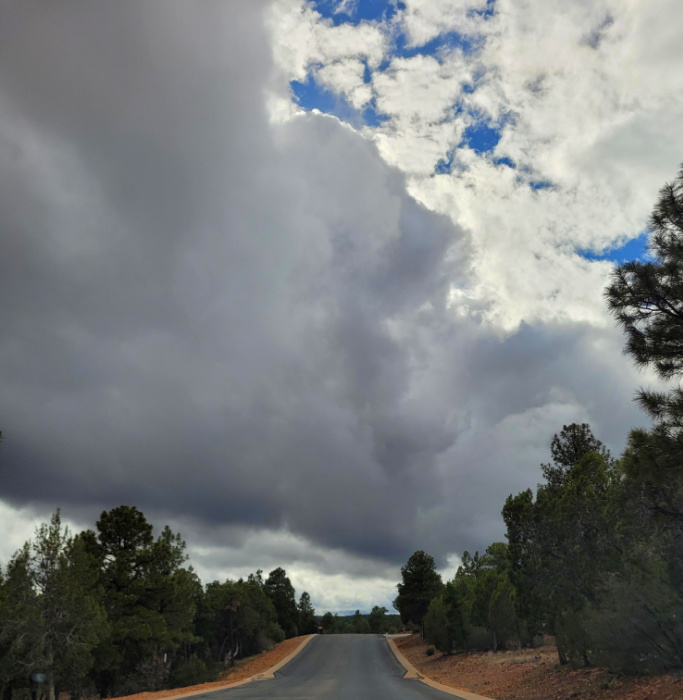
Photo… “Hello Terry, Quick picture from Show Low, AZ. There is always blue sky behind the biggest clouds.” Al Lind… Thank you Al… And thank you for your photos, please send them to tdh@terryhershey.com
Donation = Love… Your gifts make Sabbath Moment possible.
I am so very grateful.
Please Share Sabbath Moment with others. And find it on Facebook @RevTerryHershey