Daily Dose (May 27 – 30)
TUESDAY MAY 27 —
Robert Fulghum tells the story about a man named Alexander Papaderos, who grew up in a tiny Greek village on the island of Crete. When he was a young boy, his island was invaded by the Nazis, and hundreds of his fellow villagers were executed for daring to resist. Consequently, the people of Crete held a special hatred in their hearts against the Germans. After the war, Papaderos became an Eastern Orthodox priest. He had a vision for building an institute on the site of the massacre to promote peace between the people of Crete and the people of Germany. If they could find forgiveness and peace, he reasoned, anyone could. Papaderos succeeded in establishing the institute, and became a living legend.
One summer, Robert Fulghum traveled there to attend a two-week seminar on Greek culture. Fulghum writes: “At the last session on the last morning… Papaderos rose from his chair at the back of the room and walked to the front, where he stood in the bright Greek sunlight of an open window and looked out. We followed his gaze across the bay to the iron cross marking the German cemetery. He turned and made the ritual gesture: ‘Are there any questions?’ Quiet quilted the room. These two weeks had generated enough questions for a lifetime, but for now there was only silence.
‘No questions?’ Papaderos swept the room with his eyes.
So, I asked: ‘Dr. Papaderos, what is the meaning of life?’ The usual laughter followed, and people stirred to go. Papaderos held up his hand and stilled the room and looked at me for a long time, asking with his eyes if I was serious and seeing from my eyes that I was.
‘I will answer your question.’ Taking his wallet out of his hip pocket, he fished into a leather billfold and brought out a very small round mirror, about the size of a quarter. And what he said went like this: ‘When I was a small child, during the war, we were very poor and we lived in a remote village. One day, on the road, I found the broken pieces of a mirror. A German motorcycle had been wrecked in that place.
I tried to find all the pieces and put them together, but it was not possible, so I kept only the largest piece. This one. And by scratching it on a stone I made it round. I began to play with it as a toy and became fascinated by the fact that I could reflect light into dark places where the sun would never shine — in deep holes and crevices and dark closets. It became a game for me to get light into the most inaccessible places I could find.
I kept the little mirror, and as I went about my growing up, I would take it out in idle moments and continue the challenge of the game. As I became a man, I grew to understand that this was not just a child’s game but a metaphor for what I might do with my life. I came to understand that I am not the light or the source of light. But light — truth, understanding, knowledge — is there, and it will only shine in many dark places if I reflect it.
I am a fragment of a mirror whose whole design and shape I do not know. Nevertheless, with what I have I can reflect light into the dark places of this world — into the black places in the hearts of men — and change some things in some people. Perhaps others may see and do likewise. This is what I am about. This is the meaning of my life.’
And then he took his small mirror and, holding it carefully, caught the bright rays of daylight streaming through the window and reflected them onto my face and onto my hands folded on the desk.
Much of what I experienced in the way of information about Greek culture and history that summer is gone from memory. But in the wallet of my mind I carry a small round mirror still.”
(Thank you, Robert Fulghum, It Was on Fire when I Lay Down on It, Random House, 1999)
This little light of mine, I’m gonna let it shine…
And speaking of “now is the time”. On this Memorial Day we honor—and say thank you to—all those who have died while serving their country, during both wartime and peacetime. You will not be forgotten.
WEDNESDAY MAY 28 — “The question can no longer be ‘What can I expect from life?’ but can now only be ‘What does life expect of me?’” Viktor Frankl reminds us.
This is not a pep talk. This is not a test to pass. Or a list I check off for God’s thumbs up. This is permission; the invitation and the affirmation to be and to live, wholeheartedly and kindheartedly, the truth of who I am. And that truth is connected to fundamental reality that we are all walking one another home. In a world of noise, that’s easy to forget.
A grandmother takes her granddaughter to the park.
On the swing set, two children already happily swinging. A boy and a girl. The girl, gregarious, says to the grandmother, “Hi lady. What are we? Can you guess?”
The woman looked at the two children, and recognized from skin tone and features, they appeared Asian. So, she said, “Well, I don’t know. But I think you’re from Thailand? Are you Thai?” “No,” the little said shaking her head.
“Are you Vietnamese?” “No,” and another shake of the head. The woman tried two more countries, each receiving a No and shake of the head.
The little girl, now a little impatient, says, “No lady, what are we?”
“I guess I just don’t know. What are you?”
“We’re brother and sister,” the little girl said with a very big smile.
Yes and Amen.
When our narrative begins with grace and sufficiency, it births compassion, inclusion and connectedness—we are on this journey together.
And here’s the deal; God’s grace is always bigger than (and never confined by) any dogma we use to comprehend it.
Here’s another thing I believe: I’m grateful for Bruce, who often saves my emotional bacon. When I’m disheartened, I crank up Springsteen’s “This Little Light of Mine”.
To remember that the reservoir is already inside. Buried maybe. Dispirited, maybe. But still the light.
To remember that we don’t create the light. We just get to shine it.
Sadly, when we spend our energy making rules about light shining, we mistrust, and hide behind labels every time.
The little girl on the swing is my Sankofa. In previous Sabbath Moments, I’ve talked about Sankofa (from the Akan language of Ghana), associated with the proverb, “Se wo were fi na wosankofa a yenkyi,” which translates “It is not wrong to go back for that which you have forgotten.”
I need to go back to what I know to be true.
Whenever I am tempted to label and dismiss. Or live from fear. Or dismiss of my own bravery or beauty. Or hide behind dogma, I need the reminder that we are, all of us in this world, broken. And the grace of God is the glue. We will go a long way toward healing if we see vulnerability as our common bond. We are, all of us, held and sustained by God’s grace.
What makes us not see? Or forget?
Put simply, we’re not in our right mind.
THURSDAY MAY 29 — I read a statement made in the Irish Times by a Connemara man after he was arrested for a car accident. “There were plenty of onlookers, but no witnesses.”
This week we’ve been asking the question, “In a world that feels heavy and disconcerting, what exactly do we do?”
Today I have an answer. I am a witness. You are a witness.
And important to remember: this is not just something we sign up for.
No. This is an affirmation fueled with the incentive to live out—to reflect—what is already inside.
We sing, “This little light of mine, I’m gonna let it shine.” The light is alive and well inside. Every single one of us. And we can easily forget. Or, we don’t see. Or, we are drawn to find our well-being and identity elsewhere. And we overlook the truth that the light is alive and well in our brothers and sisters, including those who are too often wronged or unseen or mistreated.
“You’re a minister? Well, what do you believe?” Some church people like to ask me. They can’t help themselves. Okay, here you go.
God has a heart for those who are left out, forgotten, and excluded.
God’s grace is bigger than anything which distances and separates and wounds us.
You are God’s beloved child, and God’s love for you is unconditional.
This week my beliefs mattered, because when I see acts of exclusion, or acts that disparage inclusion, I feel it, viscerally.
You see, I was raised in a church scared silly about grace. The God I was taught to worship and obey and fear, was no different than an alcoholic father. You walked on pins and needles to avoid fury. And expected punishment (which was, sadly, always called a form of love).
In your heart, you prayed for a smile.
And when your alcoholic parent smiles, you still cower, because in your heart you know it will not last. And you know when the smile thaws, it will be your fault. You see, shame leaves a stain on your spirit.
And with that kind of God, it is no surprise that we need people on the outside, so we can point and label and condemn, and make ourselves feel better.
I appreciated Michael Gerson’s candor (in a sermon delivered at Washington National Cathedral on Feb. 17, 2019, entitled, “I was hospitalized for depression. Faith helped me remember how to live”).
“I know that—when I’m in my right mind—I choose hope.
That phrase—in my right mind—is harsh. No one would use it in a clinical setting. But it fits my experience exactly.
In my right mind, I know I have friends who will not forsake me.
In my right mind, I know that chemistry need not be destiny.
In my right mind, I know that weeping may endure for the night, but joy comes in the morning.”
Yes. And amen. And in my right mind, I know that sanctuary is a place of grace that sustains emotional and spiritual nourishment.
In my right mind, I make choices to nurture my better angels… tolerance, inclusion, generosity, restoration, open-mindedness and redemption.
In my right mind, I know that we are sisters and brothers, and “every kindness large or slight, shifts the balance toward the light” (thank you Carrie Newcomer).
Beliefs are well and good, but they only matter face to face. Gratefully, there is no special skill required, only your heart.
Yes. I am a witness.
You are a witness.
“It’s funny isn’t it?
That you can preach a
judgmental and vengeful and angry God
and nobody will mind.
But you start preaching a God that is too accepting,
too loving, too forgiving, too merciful, too kind…
And you are in trouble.”
Bishop Gene Robinson
And I learned a fun new word today. Syzygy tides. These are the extreme low tides, the ones that go way out and let you walk the beach and search for and discover all kinds of goodies. NOAA tells me that syzygy tides occur when the Earth, Moon and Sun align during new and full Moon phases, amplifying gravitational pull and leading to higher high tides and lower low tides.
FRIDAY MAY 30 — Somedays, I feel broken. Very broken. And I don’t have the words. And I don’t have the strength. Maybe you can relate.
So, how can we be a witness then? What possible difference can we make?
Well, this is interesting. You see, compassion (service and care) and healing (restoration) are not mutually exclusive. Because the light we share is born in those broken places. Which means that being a witness goes hand in glove with renewal.
In other words, we find replenishment and we choose to be a witness. This is not a pep talk. This is not a test to pass. Or a list I check off for God’s thumbs up. This is permission; the invitation and the affirmation to be and to live, wholeheartedly and kindheartedly, the truth of who I am.
Please know this my friends: it is from this self—the broken or wounded self—that compassion and kindness and tenderness and empathy and healing and reconciliation can flow.
Rwandans understood this.
Do you know the Rwandan prescription for Depression? Sun, drum, dance, community.
“We had a lot of trouble with western mental health workers who came here immediately after the genocide, and we had to ask some of them to leave. They came and their practice did not involve being outside in the sun where you begin to feel better, there was no music or drumming to get your blood flowing again, there was no sense that everyone had taken the day off so that the entire community could come together to try to lift you up and bring you back to joy, there was no acknowledgement of the depression as something invasive and external that could actually be cast out again. Instead, they would take people one at a time into these dingy little rooms and have them sit around for an hour or so and talk about bad things that had happened to them. We had to ask them to leave.”
Okay, that makes me smile real big. And does my heart good.
(This story is from a Rwandan talking to western writer, Andrew Solomon, about his experience with western mental health and depression.)
As we go in to the weekend, let us take with us this prayer from St. Therese of Lisieux (“the Little Flower”)…
“May today there be peace within.
May you trust God that you are exactly where you are meant to be.
May you not forget the infinite possibilities that are born of faith.
May you use those gifts that you have received,
and pass on the love that has been given to you.
May you be content knowing you are a child of God.
Let this presence settle into your bones,
and allow your soul the freedom to sing, dance, praise and love.
It is there for each and every one of us.”
Prayer for our week…
May God bless us with discomfort — discomfort at easy answers, half-truths, and superficial relationships, so that we may live deep within our hearts.
May God bless us with anger — anger at injustice, oppression, and exploitation of people, so that we may work for justice, freedom, and peace.
May God bless us with tears — tears to shed for those who suffer from pain, rejection, hunger, and war, so that we may reach out our hands to comfort them and turn their pain into joy.
And may God bless us with foolishness — enough foolishness to believe that we can make a difference in this world, so that we can do what others claim cannot be done.
A Franciscan blessing
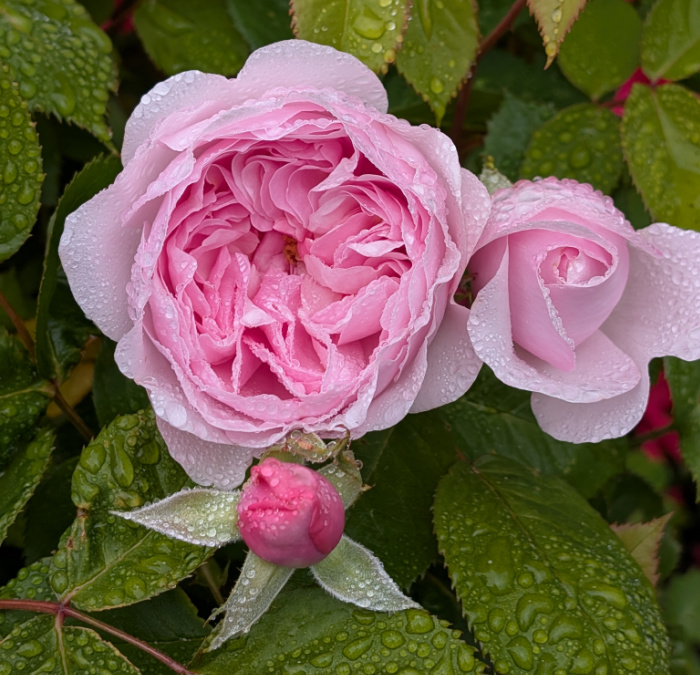
Photo… I’m in heaven with Old Garden Roses. And it’s Rose season in this neck of the woods. Meet Olivia Rose Austin, an English Shrub Rose named after the daughter of David Austin Junior and granddaughter of David Austin Senior… and thank you for your photos, please send them to tdh@terryhershey.com