Daily Dose (October 7 – 10)
TUESDAY OCTOBER 7 — When we see with our heart, we are grounded. We are conscious—present—and no longer numbed. And tender hearts create sanctuaries for those left out and for those mistreated. So, if ever there was a time for the soft- and tender-hearted courageous women and men to step forward, it is now.
Indifference is not an option.
To be blunt, indifference is a poison of the soul.
So, where do we begin?
It is blueberry pancake Sunday. In the kitchen, the young mother works under a deadline and a promise; today before church, blueberry pancakes for her two sons, their favorite breakfast in the whole wide world.
The two boys, aged 5 and 7, are fighting. Rolling on the floor, taking swings at one another over who would get the first pancake.
The mother is stressed and at the end of her rope. So, the fighting proves the final straw. She sees an opportunity for a moral lesson. “Boys,” she shouts. “Sit down! Now, if Jesus were here, he would give the first pancake to his brother.”
Well. That shuts them up.
Then the older brother says to the younger, “I have a great idea. Today, you be Jesus.”
I’m still smiling big.
And I wonder. What if today is the day to make a difference in our world?
“I believe in person to person,” Mother Teresa said. “Every person is Christ to me, and since there is only one Jesus, that person is the one person in the world at that moment.”
“Everybody can be great… because anybody can serve. You don’t have to have a college degree to serve. You don’t have to make your subject and verb agree to serve. You only need a heart full of grace. A soul generated by love.” Martin Luther King Jr.
This week, stories about the permission to serve, with soft hearts, full of grace. Not one of these people woke up one morning, and said to themselves that they were about to do something heroic. It’s just that, when they had to, they did what was right. And indifference wasn’t an option.
One of my favorite stories (which I do tell frequently) is about a still-plucky Sister Mary Antona Ebo of the Franciscan Sisters of Mary — the first black nun to march — who didn’t think she was martyr material, but felt it was time to “put up or shut up.”
On March 7, 1965, Alabama state troopers and local police — some on horseback — used billy clubs, bullwhips and tear gas to bludgeon and bloody about 600 civil rights activists who had started a march of 50 miles from Selma to the state capital of Montgomery.
News of that “Bloody Sunday” attack at the Edmund Pettus Bridge was broadcast into homes across the country and would be a turning point in the civil rights struggle. After the attack, the Rev. Dr. Martin Luther King Jr. issued a call for church leaders around the country to come to Selma. Sister Antona Ebo was working at St. Mary’s Infirmary, then a hospital for African-Americans in St. Louis, when news of the brutality in Selma reached her.
“If I didn’t have this habit on, if I wasn’t working,” she told her co-workers at the infirmary, “I’d be in Selma.”
“God called my bluff,” Ebo would later tell a reporter.
Ebo’s supervisor, Sister Eugene Smith, asked her whether, as an African-American nun, she would be part of a 50-member delegation — made up of laymen, Protestant ministers, rabbis, priests and five white nuns.
On the morning of Wednesday, March 10, the group flew to Selma. They were promptly taken to Brown Chapel African Methodist Episcopal Church — a civil rights landmark.
Ebo later realized that inside the chapel, politician and civil rights leader the Rev. Andrew Young had referred to her when he asked “the people to stand and acknowledge that one of the great moral forces of the world was now entering the church.”
“I didn’t even know that that was me,” Ebo says now with a chuckle.
Sister Mary Antona Ebo died November 2017, at the age of 93.
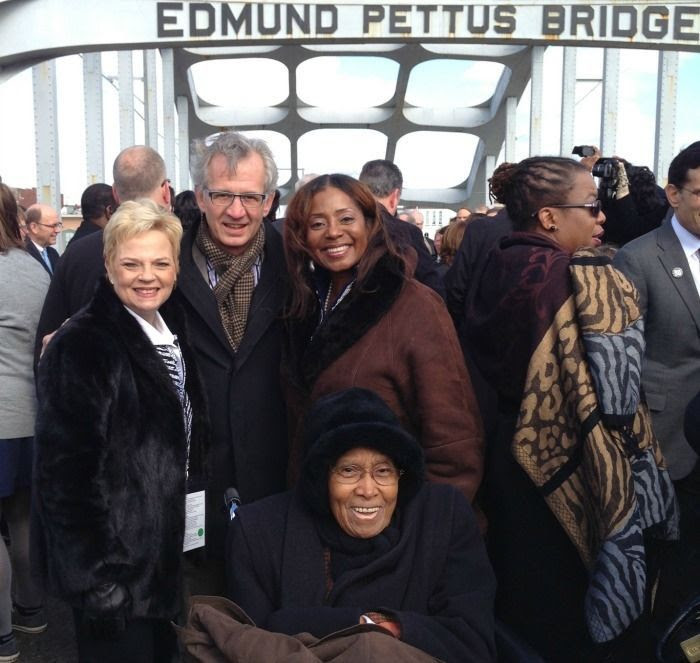
In 2013, I was honored to walk the Edmund Pettis Bridge and to stand with heroes, including Sr. Mary and John Lewis. It’s not my practice to put personal photos in Sabbath Moment. But this is my way of thanking Sr. Mary for stepping up. This is Sister Mary on the bridge, alongside Peggy Wallace Kennedy (daughter of George Wallace) and Donzaleigh Avis Abernathy (daughter of Ralph Abernathy).
WEDNESDAY OCTOBER 8 — My friend Tim Hansel wrote a book on parenting. He asked his young sons, “Boys, how do you know Dad loves you?”
He figured that they would say, “Daaaad, remember when you took us to Disneyworld, like for 10 days!” They didn’t say that, so he knew he wasted all that money.
He figured they’d say, “Daaaad, remember Christmas and you bought us all that great stuff!” They didn’t say that.
They said, “Dad, we know you love us, when you wrestle with us.”
He remembered two times. He had come home, hungry, tired, late, and he didn’t care. But these urchins were yanking on his pant leg. “So, I rolled with them on the floor. Toward the kitchen.” He said, “just to get them out of my way.”
And then it hit him. In the middle of that very ordinary, boring, mundane experience, real life was happening. Unfeigned joy, love, intimacy, connection, grace, renewal, sacrament—the really good stuff—all woven into the commonplace.
“But,” Tim laments, “I missed it. Because I was only tuned into Disneyworld and Christmas.”
There is nothing wrong with Disneyworld or Christmas. But they have meaning, only because of the sacred that is alive and well in the ordinary. Yes, because of the wrestling times.
We live in a world where we wonder if we can make a difference. “You don’t mean me, do you?”
And it doesn’t help that too many of us have been wired to see “difference making” (or service or ministry) as an obligation to complete or status to achieve. I confess that there was always a part of me that was sure I didn’t have what it took to “make a difference”. As if making a difference is about how you’re wired, or a pecking order, or a beauty pageant.
And yet. What we often fail to see is the power in the gift of presence.
Simply making the choice “to be here now”.
Love and healing and affection and impartiality are born in (and grow in) the soil of “Presence”.
“Momma, momma,” said the little boy, “Please listen to me. But this time with your eyes.”
We need this—with one another—more than ever. Every gift of presence does indeed make a profound difference.
And this week we are reminded that when we see with our heart, we are grounded. We are present. And we are conscious, and no longer numbed. And tender hearts create sanctuaries for those left out and for those mistreated. Tender hearts embrace wrestling times for those who yearn to be seen and held. So, if ever there was a time for the soft- and tender-hearted courageous women and men to step forward, it is now. Indifference is not an option.
“It is a risk to love. What if it doesn’t work out?
Ah, but what if it does.”
Peter McWilliams
THURSDAY OCTOBER 9 — The movie Crimes of the Heart (based on the Pulitzer Prize winning play written by Beth Henley) is the story about three sisters surviving crisis after crisis in a small Mississippi town. The youngest, Rebecca or ‘Babe,’ finds a sort of solace in an almost comical practice, contorting her body in order to stick her head into the oven. One day, older sister Meg asks exasperated, “Why’d you do it, Babe? Why’d you put your head in the oven?”
Babe, “I don’t know… I’m having a bad day.”
Meg, “Well… we’ve got to find a way to get you through these bad days.”
Not that long ago in a public place, I am eavesdropping. And I honor one cardinal rule: eavesdropping on a good conversation always takes precedence over whatever else is on my list.
Two women are commiserating about life’s real vicissitudes. They tell stories filled with culprits and villains. I’ll give you the abridged version. There are parents not talking with grown children. There are life-threatening medical conditions. There are relationships gone awry. There are friends who turn out not to be real friends. There are betrayals and secrets and scary systems of belief. And, there are men who are idiots. (I could have guessed that last one.)
Life is difficult, Scott Peck wrote in The Road Less Traveled.
Yes. And haven’t we all felt near the breaking point?
And listening to many people—who had the courage to reach out—that “breaking point” is weightier now than it’s ever been.
Okay, if sticking our head in the oven is not the answer, what can we do?
Here’s the deal: Yes, sorrow—darkness from pain or suffering or cruelty—is a part of life. But this darkness does not get to say how the story ends.
That is good news. We still have choices available to us. We are not at the mercy of.
One. Fear is not the final answer.
I loved the book, Tears of Salt, Dr. Pietro Bartolo’s heartrending story about hundreds of thousands of African and Middle Eastern refugees fleeing civil war and terrorism and hoping to make a new life in Europe. Pietro runs the lone medical clinic on the rocky island of Lampedusa, the first port of call. Unforgettable tales of pain and hope, of those who didn’t make it and those who did. Why keep trying? (As in, to keep trying here against all odds, makes no sense.)
“We can’t, and we won’t, be governed by our fears,” Pietro writes.
Two. We, every single one of us, can create safe (sanctuary) places.
Sqababsh (meaning Swiftwater People), is the preferred name for Vashon Island’s band of native people. (S’Homamish is another version of the name). They were known for creating safe havens for people seeking refuge from violence.
We can do that. We can do that for people we know who live with emotional or spiritual, and yes, physical harm.
Three. We can appeal to our better angels, where we are reminded that when we see with our heart, we are grounded. We are present. We are conscious, and no longer numbed.
What are we going to invest in; with our time, energy, heart and passion?
I have an idea. With our moments and day… Let us be present. We serve. We help. We hug. We heal.
So, if ever there was a time for the soft- and tender-hearted courageous women and men to step forward, it is now. Indifference is not an option.
“Do not be dismayed by the brokenness of the world. All things break. And all things can be mended. Not with time, as they say, but with intention,” L.R. Knost reminds us. “So, go. Love intentionally, extravagantly, unconditionally. The broken world waits in darkness for the light that is you.”
FRIDAY OCTOBER 10 — Have you ever felt on “the outside”?
Do you know anyone who has been shunned, or has known intolerance and marginalization?
In the Gospels (Matthew, Mark and Luke) there is a story that has touched my heart since I was a boy. It is about an “unnamed woman” (that phrase always unsettled me). This woman suffered from a chronic bleeding condition for twelve years, a condition that made her ritually “unclean”, and socially ostracized under Mosaic (Jewish) law.
In other words, she wore a label. When was an “outsider”.
And this we know; labels are very powerful.
And it is easy to let labels consume us.
We know that her “unclean status” meant she was excluded from public life, and even from religious worship. She was prohibited from touching others. After all, she would “make them unclean”. It is not surprising that this condition would have financially ruined her, as all of her resources were used looking for “medical services” that, in the end, could not help her.
This is visceral to anyone who knows pain, or suffering, or exclusion.
But I love this. Her suffering doesn’t stop her yearning for healing. She knows that Jesus is nearby, and she believes that even one touch will make a difference. She makes her way in into the crowd, and approaches Jesus as he is walking by. She reaches out, touching the fringe of his cloak. And she is immediately healed.
Jesus stops. He knows that healing power has been released.
He asks, “Who touched me?” The woman, trembling, reveals herself.
Jesus looks into her eyes and addresses her, loving, calling her “My Daughter.” “Your faith has rescued you.” He tells her. “Go in peace. Be healed from your illness.”
Here’s the power, and our invitation today: This is a story about the magnitude of compassion, for all those who are marginalized. And how Jesus’s gentle and accepting and liberating response to the woman, is in direct contrast with the societal rejection she faced.
I can tell you that in my life, I am indebted to, and grateful for, those “touches of grace and healing”—even when “societal” rules told them not to.
And I can tell you, that it is important that we all know—at our core—that we too carry that touch. To offer healing, and dignity, and restoration to anyone who is suffering or discounted.
I know that today, I will be on the lookout for anyone who is looking for, yearning for, that touch.
And this from Rev. Cameron Trimble.
“It is tempting to harden in response. To turn inward, to grow cynical or numb. But the answer to cruelty is not more cruelty. The answer is fierce tenderness. The answer is resistance rooted in compassion. The answer is a refusal to lose our own humanity, even as others lose theirs.
What breaks my heart most is not only the policies themselves, but how effective they are at eroding empathy. When good people begin to speak about others as immigrants, as progressives, as the ‘radical left,’ as less than human, something sacred is lost. The machinery of propaganda is designed to do just this. It severs us from one another. It teaches us to look at our neighbor and see not a fellow traveler, but a threat.
We are not required to agree with everyone. We are not required to abandon our values or ignore injustice. But we are called by faith, by conscience, by our own sense of decency to never forget that every person we meet is sacred. Every person, even those who have been shaped by lies, deserves to be seen in the fullness of their humanity.
This is not naïveté. This is spiritual resistance. This is what it means to hold onto the better angels of our nature while the world tries to drag us into the pit.
In times like these, truth is not a mere fact; it is an act of courage. Empathy is not a weakness; it is a weapon against dehumanization. Hope is not a passive wish; it is a decision to live as if love still matters.”
Prayer for our week…
Sometimes
if you move carefully
through the forest,
breathing
like the ones
in the old stories,
who could cross
a shimmering bed of leaves
without a sound,
you come to a place
whose only task
is to trouble you
with tiny
but frightening requests,
conceived out of nowhere
but in this place
beginning to lead everywhere.
Requests to stop what
you are doing right now,
and
to stop what you
are becoming
while you do it,
questions
that can make
or unmake
a life,
questions
that have patiently
waited for you,
questions
that have no right
to go away.
David Whyte
Photo… This is Sister Mary on the bridge, alongside Peggy Wallace Kennedy (daughter of George Wallace) and Donzaleigh Avis Abernathy (daughter of Ralph Abernathy)…. Thank you for your photos, please send them to tdh@terryhershey.com