Kindness matters
I love learning new words. This week: Quanked. Perfect.
Our world is emotionally quanked. It means “overpowered by fatigue.”
Fatigue from the barrage. The onslaught. Where it feels like nothing matters, and yet, everything matters. Maybe you can relate?
I am writing this from Orange County, California, after three days at the Religious Education Congress, where several thousand gathered to receive and embrace emotional and spiritual hydration. Our theme: “Wrapped In Mercy, Hope Renewed.” In a world often weighed down by fear, division, and uncertainty, God’s mercy breaks through as a light that renews our hope and invite us to share that hope with our sisters and brothers.
My topic: “When I was a boy and I would see scary things in the news, my mother would say to me, ‘Look for the helpers. You will always find people who are helping.’”
“We live in a world in which we need to share responsibility. It’s easy to say, ‘It’s not my child, not my community, not my world, not my problem.’ Then there are those who see the need and respond. I consider those people my heroes.”
Thank you, Mr. Rogers. (And yes, I wore my Mr. Rogers sweater when I presented.)
And I say, Amen. And yet, still we feel our “emotional earth” shake.
The news—the “immigration” detentions—unnerves. I do feel heartbroken. I can’t pretend otherwise.
So. What do we do when the ground is on tilt? When, needing safety, we are met with uncertainty, anxiety, doubt, sadness and suspicion?
Pull up a chair. Join me at the table. Let’s refill our coffee (or tea) cups and have a conversation. What do we do when our world is quanked?
Where do we find our strength and courage?
I’m not sure why, but I confess I spend too much time reading comments on social media. Mostly because I’m curious about what stokes our billion-dollar anger industry. Except, it doesn’t help my heart. I’m speechless. But that’s just it, I’m never speechless.
Which means this gets my attention.
Here’s what I know to be true. When the world tilts, it’s easy to spiral. To be at the mercy. And the news becomes the narrative for our emotional well-being and determines our motivation to say yes or no. To choose.
You see, when the world shakes, it can rattle our identity (I tend to live fearful and tight to the chest), and how we choose (it is easy not to trust, and I forgot the power of goodness and kindness and compassion).
I forget the fundamental truth that we are people on this journey together.
Yes. Here’s the deal: No one of us can make it alone.
No one of us.
And, even in the darkness, we can be a place of light.
I take heart when people stand up and say, “We get to say how the story ends.”
When life is on tilt, where do our marching orders come from?
Start here: Be kind, for everyone you meet is fighting a hard battle.
Fear says, “I’ll make you safe.”
But love says, “You are safe.”
“Love is the only way to rescue humanity from all ills.” Tolstoy wrote at the end of his life in his forgotten correspondence with Gandhi about human nature and why we hurt each other, as the global tensions that would soon erupt into World War I were building.
How? I have an idea. Let’s start one meal at a time.
“For I was hungry, and you gave me something to eat, I was thirsty, and you gave me something to drink, I was a stranger and you invited me in, I needed clothes and you clothed me, I was sick, and you looked after me, I was in prison and you came to visit me.
Then the righteous will answer him, ‘Lord, when did we see you hungry and feed you, or thirsty and give you something to drink? When did we see you a stranger and invite you in, or needing clothes and clothe you? When did we see you sick or in prison and go to visit you?’
Truly I tell you, whatever you did for one of the least of these brothers and sisters of mine, you did for me.” (Gospel of Matthew)
On a rainy Saturday night, in April 1945, a train pulled into Horni Briza’s train station. Stationmaster Antonin Pavlicek was appalled by the conditions of those on board. After prolonged arguments with the Nazi officer in charge of the train, Pavlicek managed to organize an astonishing humanitarian effort the next day by the local townspeople, who brought food, drink – and even baby clothes when they heard the cries of newborns – to the train wagons.
His first instinct, shock.
His second, kindness.
When Mr. Pavlicek saw how grateful the prisoners were for this small kindness and realized what terrible condition they were in, he had an idea. It has been by sheer chance that their train had stopped in Horni Briza but –as a devout Catholic—he wanted to do what was morally right. So, at 6:30 the following morning, Sunday, 22 April, instead of going to mass he paid a visit to Josef Zoubek, the director of the kaolin factory, and Antonin Wirth, the landlord of the Tovarni Hostinec, the local inn. He asked the two men how quickly they could prepare a large quantity of food to be given to the prisoners.
Of course, the SS Unterscharfuhrer was resistant, who saw “no point in feeding those destined to die.” After more negotiation, an agreement was struck that a canteen would be made available at the town’s expense to serve one hot meal to the half-starved women. The prisoner’s plight quickly spread.
Ten-year-old Jaroslav Lang said, “To begin with we didn’t even know there were prisoners on the train… we ran home to our mother and asked for some bread to give them. She was very afraid but still she gave us a little something.” Everyone was living on coupons at the time because of the shortages, but they gave up their own rations for those on the train. (Adapted from Born Survivors, Wendy Holden)
The world tilts. And when it does, there are still brothers and sisters “to feed”—physically and emotionally.
Is this topic tense? Yes. Complicated? Yes. “Politicized”? Yes. And yet, not one of those is big enough to keep us from being human and sources of compassion and justice. Because you never know. Next time, it could be me. It could be you.
“This part of your life is not about being a reporter,” the abbot once told Thomas Merton. “It’s about listening to your heart.”
“Vocation,” Merton wrote, “does not come from a voice ‘out there’ calling me to be something I am not. It comes from a voice ‘in here’ calling me to be the person I was born to be.”
We’ll be on our way back home tomorrow. Onward together my friends.
Quotes for our week…
“Our role in life is to bring the light of our own souls to the dim places around us.” Sister Joan Chittister
BULLETIN BOARD
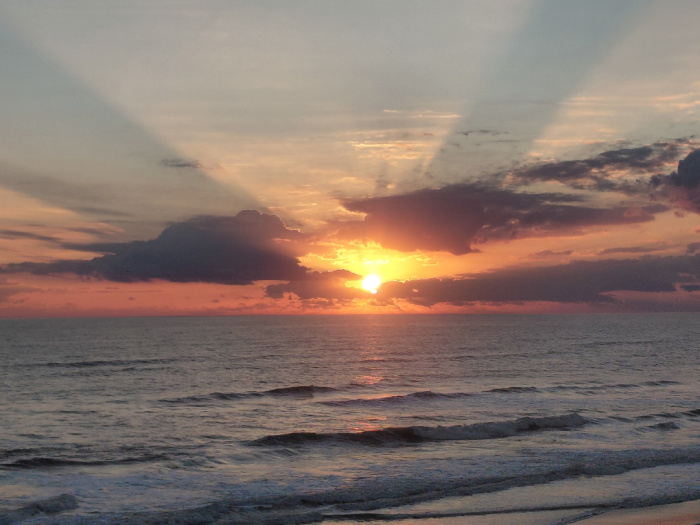
Today’s Photo Credit: “Terry, Joanie and I are still in New Smyrna Beach. Our Creator gifted us this morning with a Valentine’s Day sunrise. Grateful for this light of love.” Mick Owens… Thank you Mick… And thank you to all, I love your photos… please, keep sending them… send to tdh@terryhershey.com
POEMS AND PRAYERS
May today there be peace within.
May you trust God that you are exactly where you are meant to be.
May you not forget the infinite possibilities that are born of faith.
May you use those gifts that you have received, and pass on the love that has been given to you.
May you be confident knowing you are a child of God.
Let this presence settle into your bones, and allow your soul the freedom to sing, dance, praise and love.
It is there for each and every one of us.
St. Theresa’s Prayer
Please
If you are one who has practice
meeting the pain of the world,
we need you. Right now we need you
to teach us it is possible to swallow
what is weighty and still be able to rise.
We need you to remind us we can
be furious and scared and near feral
over injustice and still thrill at the taste
of a strawberry, ripe and sweet,
can still meet a stranger and shake
their hand, believing in their humanness.
We need you to show us how
we, too, can fall into the darkest,
unplumbed pit and learn there
a courage and beauty
we could never learn from the light.
If you have drowned in sorrow
and still have somehow found
a way to breathe, please, lead us.
You are the one with the crumbs
we need, the ones we will use to find
our way back to the home of our hearts.
Rosemerry Wahtola Trommer
| Music for the Soul… New– A Safe Place to Land — Sara Bareilles with John Legend |