Daily Dose (April 14 – 17)
TUESDAY APRIL 14 — These days, I am often asked about “suggestions” for sanity and healing and reparation. My answer “Today, let goosebumps astonish us”.
Goosebumps—making space for the softening in our chest whenever we see beauty or kindness or humanity.
This week, let us invite and welcome the healing power of goosebumps. And let us savor moments of palette cleansing awe.
I really enjoyed the movie Never Cry Wolf. It is the story (based on the non-fiction memoir) of Canadian Farley Mowat, who was sent to the northern tundra in order to study the impact of wolves on the diminishing Caribou herd. This inexperienced non-native humors the locals, as they are certain he will meet his bleak death by cold, or wolves, or both.
And yet. His curiosity wins. And Farley survives. And the land, the people and animals that live there—especially the two wolves that he names George and Angeline, who have pups, and seem as curious of him as he is of them—shape his life.
The cinematography is dramatic. There are vistas of grandeur, peaks majestic and landscapes frozen, bleak and austere. While the movie is about “wolves,” it is also about Farley’s new “eyes,” as he is being “reintroduced to wonder.” And yes, to goosebumps.
I can tell you this: along for the ride, I cherished seeing through “new eyes”.
This would make a great paradigm change question when we meet others. Instead of asking, “What do you do?” or “What did you do (accomplish)?” let us ask, “This week, when did you find (enjoy, savor, relish) moments of wonder?”
But Terry, the world feels (and is) catawampus. So, it is no surprise when we assume that wonder (or awe or joy) is not easily or readily accessible.
I don’t disagree. But gratefully, the opposite is true.
“We do not pray in order to escape the world around us,” Sister Joan Chittister reminds us. “We pray with one eye on the world so that we can come to understand what is really being asked of us here and now, at times like this, as co-creators of the universe.”
And I was grateful for this confirmation and invitation from Maria Shriver. “The volatility of this seemingly endless war has so many of us shaken, scared, and frankly, outraged. Living in that constant state of ‘fight or flight’ doesn’t just steal our peace. It’s an expensive tax on the very time we claim to value so much.
where you put your attention is where your time actually goes. You can protect your calendar and still spend your hours in distress, in dread, in toxic loops of news and noise and comparison. Or you can choose, imperfectly and stubbornly each day, to put your attention on what fills you. On joy. On awe (just look at the pictures of Earth sent by the Artemis crew). On the people right in front of you. On a walk outside, when the light is doing something extraordinary, and you almost miss it.”
As I was writing this Sabbath Moment, the doorbell rang. I went to take the delivery. Off to the side of our entry walkway are two great Camellia shrubs, now full of blooms. One shrub with a creamy white flowers, and one with a shade of blooms between carmine and ruby. The Camellia is sometimes called the Queen of flowers because of its gentle elegance.
A hummingbird calmly and steadily hovers at one of the open blooms. Wings fluttering—at a rate and speed already wondrous—the hummer savors his late lunch. And I savored the moment. In awe—and so grateful—for the wonder.
WEDNESDAY APRIL 15 — This week I received a letter that restored my heart. A balm to my soul. Well, truth be told, the letter was written and sent in 1513. Let’s just say it took a while to get to me.
You see, when I give in to the cacophony—the din and dissonance—in our daily news recently, it’s as if I “lose my way”. Well, that’s what I tell myself. And I confess that every now and again, waves of melancholy are high (depleting hopefulness and courage), and I say, “No more”.
Thankfully, I received this letter to a friend.
In 1513, Fra Giovanni Giocondo wrote to Countess Allagia Aldobrandeschi, “I salute you. I am your friend, and my love for you goes deep. There is nothing I can give you which you have not. But there is much, very much, that, while I cannot give it, you can take.
No heaven can come to us unless our hearts find rest in it today. Take heaven! No peace lies in the future which is not hidden in this present little instant.
Take peace! The gloom of the world is but a shadow. Behind it, yet within our reach, is joy. There is radiance and glory in darkness, could we but see. And to see, we have only to look. I beseech you to look!
Life is so generous a giver. But we, judging its gifts by their covering, cast them away as ugly or heavy or hard. Remove the covering, and you will find beneath it a living splendor, woven of love by wisdom, with power. Welcome it, grasp it, and you touch the angel’s hand that brings it to you.
Everything we call a trial, a sorrow or a duty, believe me, that angel’s hand is there. The gift is there and the wonder of an overshadowing presence. Your joys, too, be not content with them as joys. They, too, conceal diviner gifts.
Life is so full of meaning and purpose, so full of beauty beneath its covering, that you will find earth but cloaks your heaven. Courage then to claim it; that is all! But courage you have, and the knowledge that we are pilgrims together, wending through unknown country home.”
(Fra Giovanni Giocondo—1435–1515—was a Franciscan friar, a Renaissance pioneer, architect, engineer, antiquary, archaeologist, and classical scholar.)
So. Here’s the deal: I believe this letter is addressed to every single one of us. Because this is a Sankofa Letter. In Sabbath Moment, I’ve talked about Sankofa (from the Akan language of Ghana), associated with the proverb, “Se wo were fi na wosankofa a yenkyi,” which translates “It is not wrong to go back for that which you have forgotten.” Yes. More than ever, we need emotional and spiritual nourishment. Places of sanity and restoration… including reminders to invite and welcome the healing power of goosebumps. Letting us savor moments of palette cleansing awe. Yes, “Welcome it, grasp it, and you touch the angel’s hand that brings it to you.”
The power of Giocondo’s letter is this simple reminder; these gifts (the “diviner gifts”) live within us. Today.
And yet, for various reasons, we do not see them.
And this I know, when we do not see, a part of us shuts down.
I loved the quirky movie (with the sophisticated title) Joe versus the Volcano, about a young man who has resigned himself to slogging through life. He puts in his time at a job he detests. He is hampered by persisting attacks from a “brain cloud,” a supposedly fatal ailment. (I laugh out-loud when his friend asks incredulous, “You mean you were diagnosed with something called a brain cloud and didn’t ask for a second opinion?”)
Through a bizarre twist, Joe is presented the chance to sail to an obscure island where he is to be offered as a sacrifice to the volcano gods. Believing that he will die anyway he takes the offer. The trip, of course, awakens him from his soul-sick stupor.
And for the first time, he notices.
He sees.
He is enchanted.
He feels gooseflesh.
And he learns the lesson that it is not just where you look, but how.
“My father says that almost the whole world is asleep. Everybody you know. Everybody you see. Everybody you talk to. He says that only a few people are awake and they live in a state of constant total amazement.” (From Joe versus the Volcano)
THURSDAY APRIL 16 — In a world where disarray too easily dominates our information and media feed, Sabbath Moment is an invitation to hit the pause button. To see in the power of pause, the restorative gift of paying attention. To see. To welcome goosebumps and joy. To embrace the Sacrament of the Present.
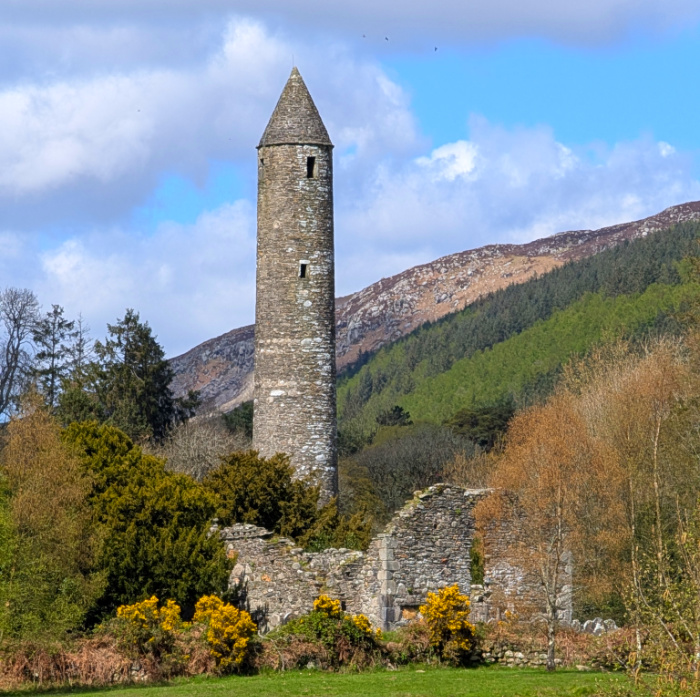
I am writing this on my flight to Dublin, Ireland, where tomorrow I will be savoring the moments in a scenic city with a remarkable history, strolling the grounds at Trinity College, founded in 1592 and steeped with moments of wonder.
And yes, I will embrace the permission to pause.
To pay attention.
But here’s the forewarning: To pay attention, we must slow down.
I can give you the part line that slowing down is a tonic for the heart and pretty much a necessity for our blood pressure. It is restorative for our emotional well-being and nourishment for our soul you pick the word: tonic, sustenance, nutriment, curative, balsamic, sanative. I have no doubt that they all ring true. People who know a lot more than I do tell me so. While we’re sorting it out though, let’s wander through the back garden and I’ll tell you what I do know for certain.
I can tell you that there is a direct correlation between slowing down and joy. You know, that felling which expands your chest and slows the world’s carousel, so that everything and everyone around you is in crystal-clear focus, and your mind has no need for approval or scheming or regret. You are content merely to be. Just to be. As if the very emotion resides in that realm of time where the heartbeat slows.
I can tell you that when I slow down, I pay attention, and I give up my need for control.
I can tell you that Quaker theologian Thomas Kelly got it right when he wrote, “listening to the eternal involves a silence within us.”
And I can tell you that when I slow down, I begin to live more openly and relaxed.
And the garden is—and has been for the last 35 years of my life—my curative and renewing teacher, inviting me to slow down.
“I can also tell you that it is a cool and blustery late October day,” I wrote in my book Sacred Necessities, “the kind of weather that sends up an unequivocal flare to let us know that summer has migrated south. Rian will be our companion for some time now. The shrubs and perennials do their best to stand tall against the southerly gusts. There are stubborn blooms on the antique roses Souvenir de la Malmaison and Comte de Chambord. They give the upper beds a certain dignity, an old-world charm. Asters, verbena, and chrysanthemum all flower cheerfully though terribly sprawled, flopped, and askew. Nuthatches continue their resolute forays to the black-oiled sunflower-seed feeder, up and down the old fir tree as furtive and urgent bandits. Wispy clouds ride a river torrent through the sky like a backdrop which has missed its cue and is hastily escorted across the stage. The air is touched with the smoke of wood stoves. And except for the nuthatches and an occasional stirring of the leaves, there is silence.”
FRIDAY APRIL 17 — In a world that feels upside down, let us not forget that joy and hope are alive and well. And in places—ordinary moments—we are “reintroduced to wonder.” And yes, to goosebumps.
So, it’s story time. By most measures, he was nondescript: a youngish white man in blue jeans, a long-sleeved T-shirt and a Washington Nationals baseball cap. From a small case, he removed a violin. Placing the open case at his feet, he shrewdly threw in a few dollars and pocket change as seed money, swiveled it to face pedestrian traffic, and began to play.
On an ordinary Friday morning in January 2007, at the L’Enfant Metro station (Washington DC), a violinist performed six classical pieces. By count, 1,097 people passed by in the gray rush of modernity. In the 45 minutes the musician played, only 6 people stopped. About 20 gave him money, but the others continued to walk their normal pace. The violinist collected $32.
The violinist began with Bach’s partita No 2 in D minor (haunting and heart-rending), on a Stradivarius violin (crafted in 1713) worth 3.5 million dollars.
Who was this unrecognized mendicant?
Joshua Bell, one of the preeminent (and most famous, not to mention good-looking) musicians in the entire world. (Joshua’s performance was arranged by The Washington Post as an experiment to see if people would actually stop and notice beauty in unexpected places.)
Would a crowd gather?
Would people willingly miss their trains or turn off their cell phones?
Would people slow down, be late for work inexplicably drawn in to the music?
The answer is no.
Or, to make it personal, would I ignore the clamor and din around me, and allow for (and be fed by) sanctuary in the presence of beauty?
We see what we expect to see.
We hear what we want to hear.
And we experience what we anticipate we will experience.
And we do it with all the instinctiveness of breathing.
We do not expect to see a world-class musician on the side of the road, so we don’t see him, even if he is there.
I needed to watch Joshua Bell…
I needed respite from the noise of the world…
Even so, there is a cynical part of me that wants to chide the Post for such an experiment. Of course, busy commuters will fail to stop and notice.
But this kind of experiment is not new. Lawrence Kushner writes that a similar test was tried a few thousand years ago. Kushner suggests that the “burning bush” was not a miracle. It was a test. God wanted to find out whether or not Moses could pay attention to something for more than a few minutes. When Moses did pay attention, God spoke.
The trick is to pay attention to what is going on around you long enough, to behold the miracle.
But then, Moses wasn’t hindered by an iPhone.
I’m sure I would have stopped, I tell myself. But, that could be wishful thinking. Here’s what I do know: I have the choice every day. It may not be a Stradivarius, but it is the music of God nonetheless.
I watched the YouTube video of Joshua’s “performance.”
Here’s the curious part: the most attention comes from a 3-year-old boy. His mother is hurried, dragging the boy along. Even so, the kid stops, to look at the violinist. Finally, you see the mother push, and the child continues to walk, all the while turning his head to listen to the music.
Throughout the video, it is the children who stop.
And all the parents, without exception, force them to move on.
The poet Billy Collins once noted that all babies are born with knowledge of poetry, because the lub-dub of the mother’s heart is in iambic meter. Then, life slowly starts to choke the poetry out of us.
It may be true with music too.
I would like to think that there is enough of a three-year-old in me that I would have stopped.
And listened.
And savored.
Even if only for a moment.
Just enough to be fed by music and beauty.
To take that gift with me into the day.
Today, spending time lingering and dawdling in parks in Dublin, Ireland. Doing our best to find our way into a new time zone. And savoring the gift of green, and the chorus of birds.
Prayer (poem) for our week…
Praying
It doesn’t have to be
the blue iris, it could be
weeds in a vacant lot, or a few
small stones; just
pay attention, then patch
a few words together and don’t try
to make them elaborate, this isn’t
a contest but the doorway
into thanks, and a silence in which
another voice may speak.
Mary Oliver
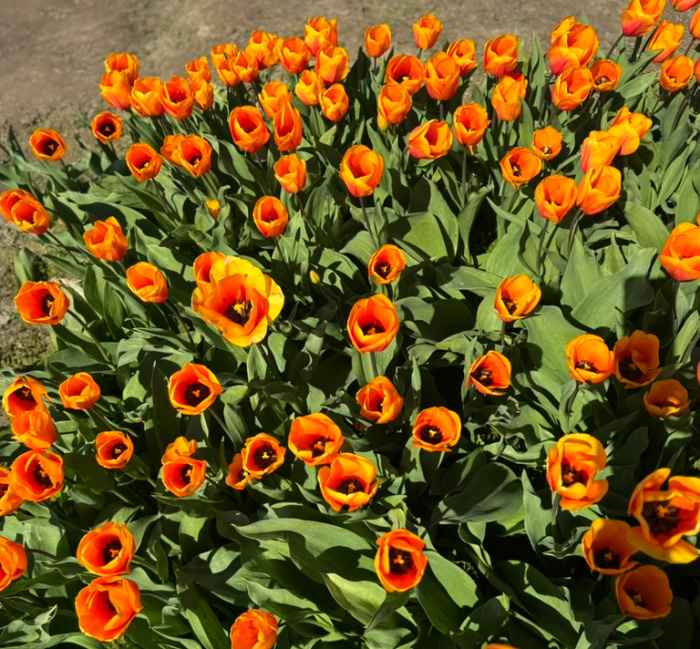
Photo… “Terry, You have been posting flowers… looking in the ‘face’ of a tulip and seeing the intricacy of it’s beauty, does cause stillness and awe! My husband and I went to the tulip fields (Skagit Valley, WA) a few days ago,” Barbara Smith (PS – Enjoy Ireland)… Thank you Barbara… And thank you for your photos, please send them to tdh@terryhershey.com
Donation = Love… Your gifts make Sabbath Moment possible.
I am so very grateful.
Please Share Sabbath Moment with others.
And find it on Facebook @RevTerryHershey