Daily Dose (August 19 – 22)
TUESDAY AUGUST 19 — Stories take care of us. Sometimes a person needs a story more than food to stay alive. That is why we put these stories in each other’s memories. (Thank you, Barry Lopez.)
And yet. There are some days when we replay only stories that encourage us to live small. And when we live small, we live reactive. Diminished. Trapped. Afraid. Without hope.
My friends, we live and choose from hope when we allow ourselves to fall into the gift of grace. Which reminds me of a story.
Jean Houston writes, “When I was about fourteen I was seized by enormous waves of grief over my parents’ breakup. I had read somewhere that running would help dispel anguish, so I began to run to school every day down Park Avenue in New York City. I was a great big overgrown girl (5 feet eleven by the age of eleven) and one day I ran into a rather frail old gentleman in his seventies and knocked the wind out of him. He laughed as I helped him to his feet and asked me in French-accented speech, “Are you planning to run like that for the rest of your life?”
“I will go with you,” he informed me.
And thereafter, for about a year or so, the old gentleman and I would meet and walk together often several times a week in Central Park. He had a long French name but asked me to call him by the first part of it, which was “Mr. Tayer” as far as I could make out. The walks were magical and full of delight. Not only did Mr. Tayer seem to have absolutely no self-consciousness, but he was always being seized by wonder and astonishment over the simplest things. He was constantly and literally falling into love.
I remember one time when he suddenly fell on his knees, his long Gallic nose raking the ground, and exclaimed to me, “Jeanne, look at the caterpillar. Ahhhh!”
I joined him on the ground to see what had evoked so profound a response that he was seized by the essence of caterpillar.
“How beautiful it is”, he remarked, “this little green being with its wonderful funny little feet. Exquisite! Little furry body, little green feet on the road to metamorphosis.”
He then regarded me with equal delight. “Jeanne, can you feel yourself to be a caterpillar?” “Oh yes.” I replied with the baleful knowing of a gangly, pimply faced teenager.
“Then think of your own metamorphosis.” he suggested. “What will you be when you become a butterfly, une papillon, eh? What is the butterfly of Jeanne?” (What a great question for a fourteen-year-old girl!)
His long, gothic, comic-tragic face would nod with wonder. Old Mr. Tayer was truly diaphanous to every moment and being with him was like being in attendance at God’s own party, a continuous celebration of life and its mysteries. But mostly Mr. Tayer was so full of vital sap and juice that he seemed to flow with everything. But perhaps the most extraordinary thing about Mr. Tayer was the way that he would suddenly look at you. He looked at you with wonder and astonishment joined to unconditional love joined to a whimsical regarding of you as the cluttered house that hides the holy one. I felt myself primed to the depths by such seeing. I felt evolutionary forces wake up in me by such seeing, every cell and thought and potential palpably changed. I was yeasted, greened, awakened by such seeing, and the defeats and denigrations of adolescence redeemed. I would go home and tell my mother, who was a little skeptical about my walking with an old man in the park so often, “Mother, I was with my old man again, and when I am with him, I leave my littleness behind.”
(Excerpts from Jean’s interactions with “Mr. Tayer.” Jean did not find out until after his death that Mr. Tayer was Teilhard de Chardin. From Jean Houston, Godseed: The Journey of Christ)
She continues, “I have often wondered if it was my simplicity and innocence that allowed the fullness of Teilhard’s being to be revealed. To me he was never the great priest-paleontologist Pere Teilhard. He was old Mr. Tayer. Why did he always come and walk with me every Tuesday and Thursday, even though I’m sure he had better things to do? Was it that in seeing me so completely, he himself could be completely seen at a time when his writings, his work, were proscribed by the Church, when he was not permitted to teach, or even to talk about his ideas? As I later found out, he was undergoing at that time the most excruciating agony that there is—the agony of utter disempowerment and psychological crucifixion. And yet to me he was always so present—whimsical, engaging, empowering. How could that be?
I think it was because Teilhard had what few Church officials did—the power and grace of the Love that passes all understanding. He could write about love being the evolutionary force, the Omega point, that lures the world and ourselves into becoming, because he experienced that love in a piece of rock, in the wag of a dog’s tail, in the eyes of a child.
Years later, while addressing some Jesuits, a very old Jesuit came up to me. He was a friend of Teilhard’s—and he told me how Teilhard used to talk of his encounters in the Park with a girl called Jeanne.”
This week let us remember that we are “a cluttered house that hides the Holy One”. True, there are many times when we may not see the Holy One in ourselves, but it shouldn’t keep us from singing, “This little light of mine, I’m gonna let it shine,” followed by, “Don’t forget to pray for those men.”
WEDNESDAY AUGUST 20 — I do enjoy watching Les Miserables (Victor Hugo’s great novel of betrayal, and redemption). There is a scene at the end of the movie version when Javert (the obsessive fanatic police inspector who has tracked Jean Valjean) has Jean at gun point, “It’s a pity,” he tells Jean, “The rules don’t allow me to be merciful.”
Let’s push the pause button here.
“Don’t allow me to be merciful.” Yes. Because that’s exactly what happens when our identity is owned by fear.
We can be constricted—not allowed—by “rules”, or creed, or public opinion, or fear of punishment, or the need to just fit in. Regardless, we don’t listen to—or trust—our heart.
This week we are learning from Benny, about listening to and trusting our heart. Benny, who showed grace and mercy, while confined to a hospital bed after being beaten by men who robbed him. “Don’t forget to pray for those men,” Benny said.
Benny’s overture of grace came from a reservoir, deep inside. It was not required. It was not done to impress.
Yes, any one of us can be selfish, petty, fearful, controlling, conflicted, wary, and driven. But Benny’s story reminds me that we have the capacity to be open, vulnerable, heart filled… yes, with the capacity to be moved, trustworthy and generous. And from that place, gratefully, hope is born and reverberates.
So. This week is about a Paradigm shift.
You are on holy ground. We are “a cluttered house that hides the Holy One”.
As opposed to, we see only the circumstances (and the labels attached). We can focus only on anger, or cruelty, or destruction, or “no mercy” and assume that is the whole reality.
When that happens, we give way to “scotoma”, meaning, we see only what we want to see.
And we miss what is fundamental: “You are on holy ground.” Beneath me, enabling me, grounding me. When I recognize and honor that, I can choose from that nourishment (fuel), meaning I can choose—make decisions—from, and with hope.
In other words, I’m not simply reacting, or needing to fight fire with fire, or hate with hate.
Benny did not respond from the expected script.
While in jail, Vaclav Havel wrote something that seems particularly relevant for us in these very trying times: “The kind of hope I often think about (especially in situations that are particularly hopeless, such as prison) I understand above all as a state of mind, not a state of the world. Either we have hope within us, or we don’t; it is a dimension of the soul; it’s not essentially dependent on some particular observation of the world or estimate of the situation.
Hope is a not prognostication. It is an orientation of the spirit, an orientation of the heart; it transcends the world that is immediately experienced, and is anchored somewhere beyond its horizons. Hope, in this deep and powerful sense, is not the same as joy that things are going well, or willingness to invest in enterprises that are obviously headed for early success, but, rather, an ability to work for something because it is good, not just because it stands a chance to succeed.” (Havel had become politically active as poet, playwright, and dissident after the Warsaw Pact invasion of Czechoslovakia in 1968 — which put him under the surveillance of the secret police. He was repeatedly jailed, the longest from 1979 to 1983. In 1989, his Civic Forum party played a major part in the Velvet Revolution that ended Soviet dominance, and he was elected president shortly thereafter.) (Thank you Robert Reich)
An overture of grace, coming from a reservoir deep inside. Amen.
THURSDAY AUGUST 21 — When life feels heavy, and our world feels daunting, we need reminders that there is a power, filled and fueled by grace, and mercy, and hope.
A power that is greater than despair.
A power that is greater than cruelty.
Somedays I hear the reassurance—of grace and hope—in a story. Somedays it is a poem. Somedays it is a song. And today I’ve been humming and singing one of my favorites. And yes, gratefully letting the tears flow.
“Reach out your hand, if your cup be empty
If your cup is full, may it be again
Let it be known there is a fountain
That was not made by the hands of men”
The song is Ripple, by the Grateful Dead
And I smile big when I hear some people’s reactions. “Really? This kind of song from a rock and roll band?”
And I say, “Yes, indeed. And amen.”
“Ripple,” explores our life as a journey, grounded by our interconnectedness (we are walking one another home), and the impact of actions—of kindness and gentleness—even the small ones, that can change the world around us.
And I love the enduring power of music—it takes root inside and when you sing it, you let the song and story and light spill.
The lyrics sound like a good homily or sermon, or even a timeless cosmic hymn right? Well, it’s known that Jerry Garcia (song author and lead singer) once commented that he thought he was a Presbyterian minister when singing it. It was like a “spiritual” to him.
It makes sense when you learn that on a typed draft of the song that has been discovered, there’s an unused verse:
“The wisest man is but a pilgrim
He will not claim to know the way
He will not promise dreams of glory
His words are few and his ways are kind”
Today, I invite us to read (and listen to) the lyrics, to the voices and sounds of hope. The lyrics invite us—as listeners—to reflect on their own lives, nourished by the enrichment that there is beauty and meaning—yes, grace and hope—to be found in the world around us.
Ripple
“If my words did glow with the gold of sunshine
And my tunes were played on the harp unstrung
Would you hear my voice come through the music?
Would you hold it near as it were your own?
It’s a hand-me-down, the thoughts are broken
Perhaps they’re better left unsung
I don’t know, don’t really care
Let there be songs to fill the air
Ripple in still water
When there is no pebble tossed
Nor wind to blow
Reach out your hand, if your cup be empty
If your cup is full, may it be again
Let it be known there is a fountain
That was not made by the hands of men
There is a road, no simple highway
Between the dawn and the dark of night
And if you go, no one may follow
That path is for your steps alone
Ripple in still water
When there is no pebble tossed
Nor wind to blow
You who choose to lead must follow
But if you fall you fall alone
If you should stand then who’s to guide you?
If I knew the way I would take you home”
Songwriters: Robert Hunter / Jerry Garcia
This week, we’ve been embracing the truth that we are “a cluttered house that hides the Holy One”. True, there are many times when we may not see the Holy One in ourselves, but it shouldn’t keep us from singing, “Reach out your hand, if your cup be empty, If your cup is full, may it be again,” followed by, “Don’t forget to pray for those men.”
(The story of “Ripple” is a reminder that sometimes the most beautiful creations come from the simplest of beginnings. A poem written by Robert Hunter in London, a melody composed on a train in Canada, and a mandolin part played by a friend all came together to create a song that has touched the hearts of countless listeners. “Ripple” is a testament to the power of music to inspire, heal, and connect us all. Thank you, Jerry Vanderzanden)
FRIDAY AUGUST 22 — This week we’ve been telling stories and playing songs about hope. Yesterday, the song, Ripple, accompanied me. Today, another one of my favorites—one of my grounding songs—kindled hope in my heart and spirit. Kris Kristofferson’s “Here comes that rainbow again”.
I see choices today—highlighted by the news—public displays of intolerance, meanness, domination and cruelty. And I wonder, “Is there any hope? And where do the seeds of kindness and gentleness and mercy grow?”
I gratefully hummed the song—Here comes that rainbow again—through the day and repeated the lyrics. The affirmation did my heart good.
It is a wonderful story that highlights the moments of kindness and small acts of generosity that brighten up ordinary lives, symbolized by the recurring rainbow—a metaphor for hope that emerges even in difficult circumstances, with a good splash of positivity. And a reminder that this is everything we’d like to believe about humanity, our capacity for both making mistakes, and being uplifted by simple acts of generosity, and our capability for making amends.
Here’s the deal: This is not a sermon or homily. This is not an obligation or assignment.
“This is what we do for each other,” Lauren Daley writes.
“This is our best side. Ain’t it just like a human to bring about a rainbow during a thunderstorm.
But it’s also just like a human to be inspired by words.
One of us takes a pen to paper, another reads it, and, in turn is inspired to write their own words.
I was inspired by Kristofferson to write this column; just as he was inspired by Steinbeck to write his song.
Aint’ it just like a human to feel after hearing music, after reading words.
Ain’t it just like a human to cry or smile after hearing a touching story. To want to sing it, write it, breath it.”
So. I invite us again, to read (and listen to) the lyrics, to the voices and sounds of hope. The lyrics invite us—as listeners—to reflect on their own lives, nourished by the enrichment that there is hope if this—kindness and generosity and mercy—is what we do for each other.
Here comes that rainbow again.
The scene was a small roadside café
The waitress was sweepin’ the floor
Two truck drivers drinkin’ their coffee
And two okie kids by the door
“How much are them candies?” They asked her
“How much have you got?” She replied
“We’ve only a penny between us”
“Them’s two for a penny, ” she lied
And the daylight grew heavy with thunder
With the smell of the rain on the wind
Ain’t it just like a human?
Here comes that rainbow again
One truck driver called to the waitress
After the kids went outside
“Them candies ain’t two for a penny”
“So what’s it to you?” She replied
In silence they finished their coffee
Then got up and nodded goodbye
She called, “Hey, you left too much money”
“So what’s it to you?” They replied
And the daylight was heavy with thunder
With the smell of the rain on the wind
Ain’t it just like a human?
Here comes that rainbow again
Kris Kristofferson
(Kristofferson wrote the song, which was inspired by the lunch counter scene in Chapter 15 of John Steinbeck’s Dust Bowl novel, Grapes of Wrath.)
This week, we’ve been embracing the truth that we are “a cluttered house that hides the Holy One”. True, there are many times when we may not see the Holy One in ourselves, but it shouldn’t keep us from singing, “Ain’t it just like a human?
Here comes that rainbow again,” followed by, “Don’t forget to pray for those men.”
Prayer for our week…
Expectant God
The heavens can no longer hold your abundant love,
So you pour out the gift of your embodied self
Relinquishing the beauty of your majesty,
To adorn the pale colours of our humanity.
Choosing to enter into this world in a place of scarcity and need.
Reveal to us this hidden world
of poverty,
of refugees,
of suffering.
As you choose this as the place of your birth
Let us choose this to be the place of our rebirth.
Rebuild us,
Transform us,
Make us anew.
We ask this through Christ our Lord,
Amen.
Kieran O’Brien
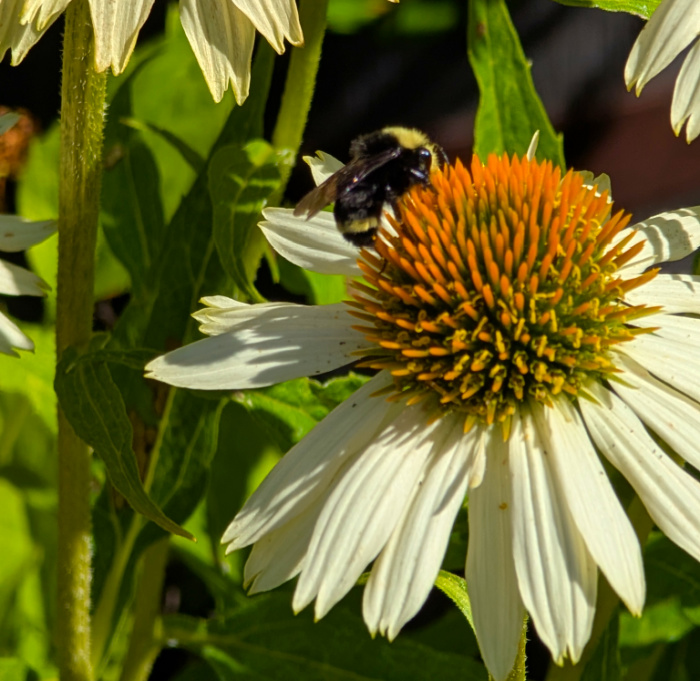
Photo… Yesterday, on my return home to Port Ludlow, from NM, the bees greeted me in the garden, savoring their time with the Echinacea… and thank you for your photos, please send them to tdh@terryhershey.com