Daily Dose (August 5 – 8)
TUESDAY AUGUST 5 —
More than ever, I’m drawn to stories of everyday heroes, ambassadors for our collective soul. These stories are indispensable for wellbeing and an antidote to despair.
Some stories are good for whatever ails us.
The husband knew he could not adequately care for his wife, now in the final stages of Alzheimer’s. He found a compassionate facility, and visited her every day. At noon for lunch.
Not 11:59.
Not 12:01.
Noon. Every day.
Until the day of a minor accident when he found himself in an Emergency Room, his arm being stitched by a nurse as the clock approached the noon hour.
“I need to leave,” he said ill at ease.
“Hold on,” she told him, “we’re not finished here.”
“But I must visit my wife at noon,” he said.
“Well,” she told him gently, “today you can be a little late.”
The man told the nurse the story of his wife and of the facility where she lives and how when he visits, she does not even recognize him, does not know who he is.
The nurse patted his hand and said, “That’s okay hon. You can relax. If she doesn’t even recognize you, there is no harm in being late this one day.”
“No,” the man insisted. “I need to go. I need to be there at noon. I know she doesn’t recognize me. But I need to be there because I still recognize her.”
Or, to put a spin on Teilhard de Chardin, “the whole of life lies in seeing the world sacramentally.” And this is not sheer sentimentality. When we do live sacramentally, there is a “price to pay”, because we are connected—consciously and compassionately and empathetically—to this place and to each another and to the sacred at the core.
And Yes. Honoring that we are on this journey together.
Living sacramentally finds its footing in ritual. Rituals are more than just repetitious behavior. There is something fundamental going on here, vital and palpable.
Because here’s the deal: Rituals remind us to Pause. In order to pay attention.
Remembering Einstein’s wisdom, “Not everything that can be counted counts, and not everything that counts can be counted.”
They can be places where we are able to receive. And places from which we give; wholeheartedness, joy, compassion, sorrow, kindness, grace, forgiveness, gladness.
“I need to be there,” he said… because this matters.
WEDNESDAY AUGUST 6 —
Gabrielle Roth reminds us that in many shamanic societies, if you came to a shaman or medicine person complaining of being disheartened, dispirited, or depressed, they would ask one of four questions.
“When did you stop dancing?
When did you stop singing?
When did you stop being enchanted by stories?
When did you stop finding comfort in the sweet territory of silence?”
I love that the shaman didn’t ask, “When are you going to quit worrying?”
Speaking of the power of music and people who stand up to the madness; this is from the blog of Bob Dawson. “I have Parkinson’s. A friend bombarded me with the Blues. I started to dance, and groove, and visualize. Music on—disease much better. Music off—symptoms come back. How come? I found out that there are Parkinson’s patients who cannot walk, but they can dance. What’s up with that?
This site does not contain a cure for Parkinson’s.
I do not know if music and dance can help everybody. If you have Parkinson’s, it is my personal, non-scientific opinion that you should find music that you get off on, play it Loud. And start to move to the music. Every day. Dance as therapy. Dance for flexibility, strength, endurance. Dance for joy. Dance in defiance of the disease.”
Yes. My friends, let us dance in defiance of the “bombs” in our world (of cruelty and hatred and disinformation and unkindness… yes, of every form).
Many years ago, in a true winter blizzard, my son Zach (quite young at the time) and I needed to take the afternoon ferry from Seattle to our island. I was cold and ornery. Zach is shuffling along in the snow, past a cluster of waiting commuters huddled together for warmth. They reminded me of a waddle of penguins, huddled and somber. Zach is kicking snow, oblivious to the downside of this weather or this moment. He is repeating, over and over, “This is soooo great. This is soooo great.”
Here’s the good news. We simplify our lives (hit the reset button) not by theory, or a 7-step-program for life management. We simplify when we pause a spell.
When we pause, we SEE.
When we pause we find our own voice.
When we pause, we take the power back from worry.
When we pause we can practice the sacrament of the blessed present.
And there, we dance.
And there, we sing.
Rilke once wrote of how he learned to stand “more seeingly” in front of certain paintings. And that’s what I want. To live this moment more “seeingly.”
Know this. Every one of these “more seeingly” moments is a deposit to our spiritual and emotional well-being, a deposit of joyfulness, enchantment, gladness, awe, delight, peacefulness and investment.
“Don’t ask what the world needs,” Howard Thurman wrote. “Ask what makes you come alive, and go do it. Because what the world needs is people who have come alive.”
THURSDAY AUGUST 7 — Invited to guest preach at another parish, Rev. Barbara Brown Taylor asked the priest, “What do you want me to talk about?”
“Come tell us what is saving your life now,” he told her.
Taylor writes, “I did not have to say correct things that were true for everyone. I did not have to use theological language that conformed to the historical teachings of the church. All I had to do was figure out what my life depended on. All I had to do was figure out how I stayed as close to that reality as I could, and then find some way to talk about it that helped my listeners figure out those same things for themselves.” (From An Altar in the World)
“Figure out what my life depended on.”
Let’s begin here: when we are not grounded (when we are depleted, or feel at the mercy of, or we lose our way) we need replenishment. We need re-grounding.
The gardener in me gets this. It’s the dirt that really matters.
When we focus only on the “flowers”—(what will people say or think?)—what really matters (the dirt they grow in, or “what my life depends on”) gets lost, hidden, unseen. In other words, we don’t draw on it.
This I know: Soul nourishment and replenishment grows from the soil (the “dirt”) of grace… and affirmation and compassion. Yes, self-care. And to nourish and replenish my soul begins here: peace and gentleness to oneself. Care of every kind begins with self-care.
From that place, I can help “my listeners figure out those same things for themselves.” And in that connection, we gratefully honor that hope, renewal, rebuilding, kindness, forgiveness, reconciliation and human dignity still exist.
Speaking of connection and hope, this poem from Rosemerry Wahtola Trommer does my heart good today.
What Comes Next
(“There’s a place in my brain where hate won’t grow.”
Naomi Shihab Nye, ‘Jerusalem’)
The man in Palestine runs
toward airdropped parcels,
is shot in the back of his head.
The military says such a shot
was never fired. The dead man
does not argue back. His body
is carried away with medicine,
dried beans, sacks of flour.
How many more must weep?
This world. This world with its
guns and fear and righteousness.
Whether or not we hold the gun,
we all have a finger on a trigger.
What else can we do with our hands?
I want to believe in a goodness
that persists despite cruelty—
not a fairytale story with a wand
or a genie, but a real story in which
a real woman grows peaches and gives
them away for the joy of giving.
A story in which a man helps another
man build a home with a bed, an oven,
a roof. War comes so quickly.
Peace comes so slow. I want to believe
there is in all of us a place
where hate won’t grow.
I want to feed that place in myself.
I want to listen to that place in you.
I want us to live into another possible world,
discover what else our lives can do.
Rosemerry Wahtola Trommer
FRIDAY AUGUST 8 — I have moments when hope feels too far away.
That’s why this week I am grateful for Karim Wasif. He is one of my heroes.
In April 2015, a car packed with explosives detonated in the busy Mansour district of Baghdad, killing at least 10 people and injuring 27. After this incident, something very unusual happened. Karim Wasif went to the bombsite, took out his cello, sat down on a chair amid ash and rubble in a black suit, his long hair combed back, and started to play.
Why go to the site of a car bomb to play your cello?
Wasfi, the renowned conductor of the Iraqi National Symphony Orchestra, said simply, “The other side chose to turn every element, every aspect of life into a battle and into a war zone. I chose to turn every corner of Iraq into a spot for civility, beauty and compassion. I wanted to show what beauty can be in the ugly face of car bombs, and to respect the souls of the fallen ones.”
We do know that when he played, soldiers cried. People kissed. They clapped, they danced, they felt alive, they felt human, and they felt appreciated and respected. This does not surprise me. When I watch the videos, I cry too. Tears of solidarity and sadness and joy. Because gratefully, it touches something deep inside of me.
This invitation is for every one of us.
So. What does it mean to embrace, and draw upon, the gift of music and dance?
Reverend Otis Moss (senior pastor at Trinity United Church of Christ in Chicago) tells a story about a time when he and his church were under attack, some years ago. They were receiving dozens of death threats every week, “We’re going to kill you.” “We’re going to bomb your church.” At the time, he was a new preacher and a young father. The situation was dire. One night he was awakened by a noise in his house and he trepidatiously got up to see what was going on. He peeked into his daughter’s room, and he describes:
“There was my daughter Makayla dancing in the darkness—just spinning around, saying, ‘Look at me, Daddy.’
I said, ‘Makayla, you need to go to bed. It is 3 am. You need to go to bed.’ But she said, ‘No, look at me, Daddy. Look at me.’
And she was spinning, barrettes going back and forth, pigtails going back and forth.
I was getting huffy and puffy wanting her to go to bed, but then God spoke to me. ‘Look at your daughter! She’s dancing in the dark. The darkness is all around her but it is not in her!’
Makayla reminded me that weeping may endure for a night, but if you dance long enough joy will come in the morning. It is the job of preachers, to send this word to us in the hardest of times: do not let the darkness find its way to you.”
(The Amen Effect, Rabbi Sharon Brous)
I carry Sojourner Truth’s wonderful affirmation in my heart, “Life is a hard battle anyway. If we laugh and sing a little as we fight the good fight of freedom, it makes it all go easier. I will not allow my life’s light to be determined by the darkness around me.”
Seeing his daughter dance inspired Rev. Moss to share the message with his community: “Sunday, I told the congregation that we must meet the threats in our lives. We must fight for justice, for our safety, and for the right to live in a world where we can thrive. But even in the darkness of midnight we can maintain a connection to the light. When we cannot survive in darkness by using visual tools of sight, we still have internal tools of memory to remind us of our terrain. Until dawn comes, we need more than the determination to fight for justice. We need love to keep us from getting lost in distraction, love to keep us from falling into despair, love to help us restore ourselves, get back into harmony with ourselves, so we can last through that dark night.
‘Dance,’ I urged them. ‘Dance in the dark!’”
(from Otis Moss, Dancing in the Darkness)
Let’s remember our invitation: in adversity, the medicine of music and dance allows us to show up, to reclaim our heart.
And in times of darkness, music and dance become fertile ground for generosity of spirit. For mystery and vulnerability, for tenderness and risk. And yes, even, and especially, joy.
Prayer for our week…
Morning Prayer: Last Light, First Breath
Today, I wake at a threshold.
One foot still rooted in sanctuary,
the other stepping toward becoming.
May I carry with me
what softened me,
what surprised me,
what reminded me I am still worthy of wonder.
May I leave behind
what no longer fits;
old armor, old ache, old doubt.
I offer this day
as a quiet hallelujah.
Not loud, not polished;
just mine.
Let what was planted here
take root in the real world.
Let what was witnessed here
continue to bloom.
And if I forget,
may grace find me anyway.
In laughter.
In wind,
In the face of another woman
who knows.
Amen.
Kerry O’Brien
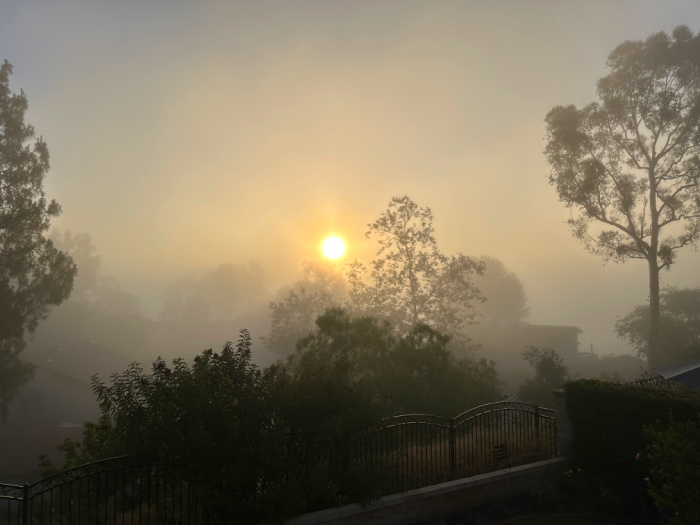
Photo… “Hello from Southern California! I woke up yesterday morning and this was the first view out my bedroom window. Skies like this are a greeting from God to me… saying goodbye to July and welcoming August. And you can see ultimate metaphor in the view… Although life may be hazy right now, God’s light is piercing through reminding us He is always here for us. God bless your day and your ministry.” Ann Miller (Anaheim Hills, CA)… Thank you Ann… and thank you for your photos, please send them to tdh@terryhershey.com