Daily Dose (March 24 – 27)
TUESDAY MARCH 24 — An elderly carpenter is eager to retire. He tells his employer (a very well-respected contractor) of his plans to leave the house-building business. He wishes to live a more leisurely life with his wife and extended family. He knows he will miss the paycheck, but it’s kick-back time and he needs to retire. And his family will get by. “I’ve hammered enough nails in one lifetime,” he tells his employer, with a laugh. There’s no need to put myself out any longer, he tells himself. The contractor is very sorry to see his best carpenter go, and asks this, “Would you be willing to oversee the building of just one more house, as a personal favor to me?”
Hesitant, the carpenter says yes. In a short time, it becomes easy to see that his heart is not in his work. No surprise that he resorts to substandard workmanship and uses inferior materials. It is an unfortunate way to end a dedicated career.
When the carpenter finishes his work the employer comes to inspect the house. The contractor hands the front door key to the carpenter.
“This is my gift to you,” he says. “This is your house.”
Most of us have been there. Holding those keys. And this is certain: it never helps slip sliding down the if-only-stream. We know where that takes us.
In my memory I’m back in southern Michigan, the son of a brick mason. I’ve been on countless constructions sites. Most of them as a hod carrier (mixing mortar, lugging bricks). So many days eager to quit. And hearing my father’s words, “Son, build this one like you’re building your own.” (Twenty-six years ago, my father helped me build my house on Vashon Island.)
Here’s the deal: We forget, or we do not see, that we make a difference, with every nail we hammer, each board we choose, each brick we mortar, each window we put in place.
And here’s the deal: because we live in a culture of bluster and ado, we forget that we can make a difference. So. More often than not, the wrong people get all the attention. (Okay, my confession, I forget that I can make a difference, one nail at a time.)
I’m with David Orr here, “The plain fact is that the planet does not need more successful people. But it does desperately needs more peacemakers, healers, restorers, storytellers, and lovers of every kind.”
Here’s to the restorative power of small gestures… one nail at a time.
We are, all of us, builders.
We are, all of us, about the business of building places and spaces for human dignity and inclusion.
Building spaces for kindness and compassion and mercy.
Building spaces for justice and hope.
Building spaces for resilience and confidence, and courage and safety and wellbeing. But this is important. This parable is not meant to scold us into making a difference. It’s a recognition that we have been created and are able to do so. This is not about bootstraps and will power and consternation. This is about letting the language of our (replenished and not overwhelmed) heart speak. Letting the light inside—the Imago Dei—spill.
Yes. Inside every one of us—in our DNA—we have the tools that we need, to navigate these unpredictable times. Yes, the “tools” to be builders—the empowerment to draw upon mercy and compassion—to create (“build”) places of sanctuary, and healing, and grace, even where cruelty and callousness are real.
When I live from overwhelmed, I react, I live fearful, and I give in to cynicism. No wonder the first to go are my courage, and my ability to laugh. Which is not good considering that they both come from the same muscle in our heart.
As builders, this is abundantly clear: We are connected. Every single one of us.
“Whatever affects one directly, affects all indirectly. I can never be what I ought to be until you are what you ought to be. This is the interrelated structure of reality,” Martin Luther King Jr. reminds us.
Receiving his induction into TV’s Hall of Fame, Fred Rogers tells the audience, “We are chosen to be servants, it doesn’t matter what our particular job.”
And speaking of builders, our geese (Irv and Dottie) are back, nesting season here in the Pacific Northwest. They return to the same spot every year. And My Oh My, it’s always a treat to welcome them. And yes, we’re hoping for goslings sometime in the next few weeks.
WEDNESDAY MARCH 25 — There’s an uplifting story about a conversation between a young pastor and a seasoned pastor. The young pastor’s church was exploding, couldn’t stop the growth, utterly out of their control. An inexplicable and unstoppable phenomenon, and with it an accompanying irritation, weariness and second-guessing.
“But you’ve built this, and it’s okay to say that,” the seasoned pastor says.
Preferring the narrative of wild and unexplained growth, the young pastor is incredulous, and responds, “But of course, we had nothing to do with it.”
“Well, not nothing,” the seasoned pastor responds. “After all, you did keep putting up more chairs.”
Yes. This is a story about the day we choose to take ownership of our lives.
We can put up chairs, and we can also take them down.
Here’s what I wrestle with; exhaustion makes me reactive. Because my focus is dictated by circumstances.
Yes, exhaustion and exasperation are real.
Yes, there is a physical and mental impact.
But it is never the whole of who I am.
And the circumstances do not get to say how the story ends.
People tell me, “I can’t watch the news these days.”
“Why is that?” I ask.
“Because there’s not one thing I can do about any of it. It’s easier to keep my head down and go about my daily life.”
When we believe that we are at the mercy of, we pretend we don’t have a choice, or are along for the ride. Which means that we no longer have the energy to give, to those things that really matter.
This is no different than the man riding a horse, galloping frantically down a path. His friend, who is sitting by the side of the road, calls out “Where are you going?” The man replies, “I don’t know. Ask the horse!”
“However mean your life is,” wrote Thoreau, “meet it and live it; do not shun it and call it hard names.” Mean, or unexpected, or confusing, or exasperating.
Well, I’m glad to say that life’s meanness does not have to be disheartening to me. On the contrary. I can lift my head, open my eyes, and see an invitation.
I can be astonished by what is (you know, the chairs that seem to fill on their own). Or, I can see this invitation to say, “Yes, I do set up chairs.”
And yes, I have a voice.
With that voice, I can hate. Or I can build.
Yes. Inside every one of us—in our DNA—we have the tools that we need, to navigate these unpredictable times. Yes, the “tools” to be builders—the empowerment to draw upon mercy and compassion—to create (“build”) places of sanctuary, and healing, and grace, even where cruelty and callousness are real.
Yes. I can set up chairs for inclusion and reconciliation.
Chairs for community and hope and courage.
So. Let’s begin with Clarissa Pinkola Estes’ reminder; “Ours is not the task of fixing the entire world all at once, but of stretching out to mend the part of the world that is within our reach. Any small, calm thing that one soul can do to help another soul, to assist some portion of this poor suffering world, will help immensely.”
THURSDAY MARCH 26 — An old Cherokee is teaching his grandson about life. “A fight is going on inside me,” he tells the boy. “It is a relentless fight that takes a toll, and it is between two wolves. One wolf is evil. He is a mixture of rage, envy, sorrow, regret, greed, arrogance, self-pity, guilt, resentment, inferiority, lies, false pride, superiority, and ego.”
He continues, “The other wolf is good. He is a mixture of joy, peace, love, hope, serenity, humility, kindness, benevolence, empathy, generosity, truth, compassion, and faith. And this same fight is going on inside you—and inside every other person, too.”
The grandson thinks about what his grandfather tells him for a minute, and then asks, “Which wolf will win?”
The old Cherokee replies, “The one you feed the most.”
There are many versions of this parable. Some with dogs instead of wolves, but all with the same general invitation, to ask what and how we feed—what we pay attention to, make space for, honor, allow to take root in our heart or spirit—that which molds us, and makes us who we are.
And we can easily do this, without conscious consent. Much of our “belief system” (meaning the ground from which we choose, and the fuel that sanctions us to make our choices about right and wrong) can be housed in (let’s call it) the unintentional closet. “Well, I didn’t really mean that.” “I didn’t really mean to say, or do that.”
So. Let us pause. And take this invitation to heart: “Don’t tell me what you believe, show me how you behave, and then I will know what you believe.”
In The Well Gardened Mind, Sue Stuart-Smith tells the story of the book L’enfant et les sortilèges (The Child and the Spells) by Melanie Klein.
The plot, based on a story by Colette, starts with a little boy being sent to his room by his mother for refusing to do his homework. In his banishment, he embarks on a rampage of fury, reveling in destruction as he trashes his room and attacks his toys and pet animals. Suddenly, the room comes to life, and he feels threatened and anxious.
Two cats appear and take the boy out to the garden, where a tree is groaning in pain from a wound he inflicted on its bark the day before. As he starts to feel pity and lays his cheek against the tree trunk, a dragonfly whose mate he recently caught and killed confronts him. It dawns on him that the insects and animals in the garden love one another. Then a fight breaks out when some of the animals he has previously hurt start to retaliate by biting him. A squirrel is injured in the fray and the boy instinctively takes off his scarf to bind its wounded paw. With this act of care, the world around him is transformed. The garden ceases to be a hostile place and the animals sing to him of his goodness as they help him back to the house to be reunited with his mother.
As Klein described: he is restored to the human world of helping.
Restored to his own heart, and restored to what is at his core.
Children (meaning the child in all of us) need to see positive confirmation of themselves in the world around them and they need to believe in their capacity to love, a capacity fueled by embracing vulnerability even in pain and suffering.
Yes, and amen. Even in a world of cacophony, and what feels like heartlessness, we are still connected to one another. We still can and do, make a difference.
A human world of helping.
No one of us is on this journey alone.
And maybe today, the armor can come down.
FRIDAY MARCH 27 — My confession is that there have been times in my life and ministry when neutrality (deliberately staying out disagreements or conflicts) was applauded. Even revered. Somehow seen as a skill, and a strength.
I told myself to not speak up about any number of social moral issues—bullying, abuse, war, sexual orientation—because I didn’t want to offend. Or lose parishioners. Or readers.
And here’s the irony: to not choose, is to choose.
I said I was a follower of Jesus.
But here’s the deal.
Jesus wasn’t neutral. In his choices, or in the stories (parables) that he told.
Bottom line: As the Good Samaritan teaches us—when there is a wounded, or broken, or distressed, or even despised human being by the side of the road, you don’t walk by. You choose to stop. To care. To invest. To heal. To reconcile. To say no to intolerance.
As a young pastor, I remember saying often, “Let’s just agree to disagree.”
Which is all very well and good, but should be reserved for things like, “I don’t like coffee.” Or, “Do we have to sing those hymns every Sunday?”
When it comes to honoring human dignity, it is not a difference of opinion. It is a difference in morality.
Jesus wasn’t neutral with regard to treating each and every human being with dignity.
My friends, let us choose to do the same: To honor dignity… regardless of race, religion, color, creed, sexual orientation or citizenship status.
Today, I am so grateful for the sabbath moment community. And our reminder to say yes to sanctuary, inclusion, empathy, compassion and kindness. And so grateful for sabbath moment readers like Michele who remind me to not turn a blind eye, or walk by.
“Dear Terry, I’m a nearly 73-year-old reader who has found great kindness, wisdom and support in reading your messages for a good while now and I am writing you to ask that you continue to share the truth of this moment, these days and our deeply troubled hearts and psyches. I open your messages now to find realistic, credible friendship and support in these frightening moments. I believe that ignoring what is happening, the dark divisions that are being encouraged by those in power win ultimately destroy us and our planet. Silence is complicity.
The Old Testament gave us many examples of a people who cried and wept about their plight; our Lord felt righteous anger and lonely desperation in his final days. Worldwide, we now find ourselves in such circumstances. And I, for one, want someone to ‘walk the Camino’, share their walking stick and offer their own wisdom as a companion to me as I put one foot in front of the other on this arduous journey and critical resistance. With appreciation for your honesty and spiritual wisdom, Terry.” (Thank you, Michele)
I know many of you will be a part of the rallies tomorrow. And yes, I will be too. Someone asked, “What is the theological basis for choose to march?”
You and I are connected. We are on this journey together. And gratefully, this we learned and absorbed from our brothers and siters recently in Minneapolis, MN.
I love this Sikh greeting… “You are a part of me I do not yet know.” (From “Sage Warrior,” by Valarie Kaur). As as children of God, we are all—every one of us—related.
“Rallies and protests are powerful, important things.
They are a necessary visual reminder that we’re not alone.
They help provide a sense of agency in dark days, to help our minds right-size the threats that seem so towering and so beyond our reach.
They give us a chance to stand with a chosen community and be a tangible response to the things that burden us.
They connect us with people we live, work, and study alongside and give us the chance to forge partnerships and build coalitions.” (Thank you, John Pavlovitz)
And yes, I’m an avid sports fan. And yes, I’m rooting for Michigan in the March Madness sweet 16 games. And looking forward to going to a Seattle Mariner baseball game this weekend with my son Zach. Yes indeed, sports still has the power to bring us all together.
Prayer (poem) for our week…
Love God.
Love a neighbor.
Be a neighbor,
and let us not complicate things
by arguing about the specifics.
You know what it means to do love
because some time or another
you have been on the receiving end of love…
If you want the world to look different
next time you go outside,
do some love.
Do a little or do a lot,
but do some,
and do not forget to get some for yourself…
Just do it,
and find out that when you do,
you do live and live abundantly,
just like the man said.
Barbara Brown Taylor
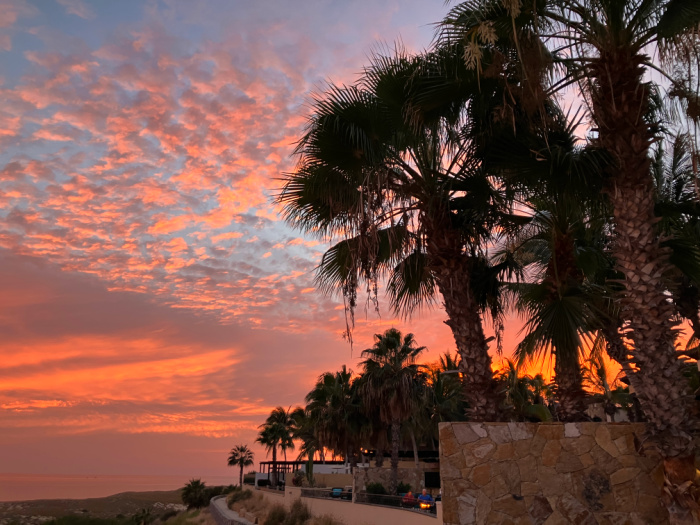
Photo… “Hello Terry, I spent a couple of weeks in Cabo recently. The trip started off a bit after the violence in Puerto Vallarta and about the same time as the attack on Iran. It was hard to remain in the present while a place I’ve been that holds family, is being bombed by my own country. As it turns out, it was the ‘small’ things–which are, and have never been, small at all–that got me through, and continue to do so. The comfort and understanding of loved ones, the warm water, the migrating humpback whales, the fire dancing in its pit, the sunsets (pic attached), the birdwatching. A little margarita didn’t hurt either. So grateful for you walking with us via Sabbath Moment, for all the reminders to help keep us intact.” Mary Ajideh… Thank you Mary… And thank you for your photos, please send them to tdh@terryhershey.com
Donation = Love… Your gifts make Sabbath Moment possible.
I am so very grateful.
Please Share Sabbath Moment with others.
And find it on Facebook @RevTerryHershey