Daily Dose (September 9 – 12)
TUESDAY SEPTEMBER 9 — Caroline was very sad. Caroline was only six years old, and her father had just died. In fact, her father had been assassinated.
Sitting in the back of big black limousine, Caroline Kennedy didn’t quite know what to do with her sadness. On the seat next to her sat her nanny, Maud Shaw, and next to Maud, Caroline’s younger brother, John.
Through the windshield Caroline could see her mother, Jackie, and her uncles, Robert and Ted, walking in front of the limousine as it slowly made its way down the Boulevard to St. Matthew’s Cathedral.
Looking out of her side of the car, Caroline recognized the friendly face of Secret Service agent, Robert (Bob) Foster. She liked and trusted Bob Foster.
Not knowing what to do with her sadness, and on impulse, she rolled down the window and stuck out her six-year-old hand.
Agent Foster had a choice to make.
Secret Service agents are not allowed to have their hands occupied, needing to be ready for any emergency. But Bob Foster didn’t even think twice. He held Caroline’s hand tightly the entire way to the cathedral.
Later, Agent Foster said it was all he could do to “fight back his own tears of sadness, for little Caroline Kennedy.”
When asked about his kindness, he seemed surprised, “All I did was hold a hand,” he answered.
This I know. We live in a world where hands need to be held. For comfort, for reassurance, for encouragement, for healing, for camaraderie, for hope.
And Robert Foster didn’t think twice about holding a hand that needed to be held. And he wasn’t posturing, or amassing heavenly brownie points. He was doing what needed to be done.
Here’s the deal: we don’t need more remedies or advice. We need more touch. We become more human when we touch.
When we touch, we are seen.
“I see you. You Matter.”
When we are seen (or emotionally fed) we recognize that our value is not tied solely to our sadness (or our grief or despair).
Here’s the good news: The bounty from compassion is not predicated on life as we expect it.
The replenishment from grace doesn’t start when our fear is gone.
Or when our beliefs are unadulterated.
Or when our circumstances make it feasible.
Most likely, if we wait for all that, we miss rebirth, comfort, healing, being fed to fullness… and the miracle, every time.
I have an idea… This week, be on the lookout for “slow moving limousines”. You never know when you will see a hand that needs to be held.
“There’s a light in this world, a healing spirit more powerful than any darkness we may encounter. We sometimes lose sight of this force when there is suffering, too much pain. Then suddenly the spirit will emerge through the lives of ordinary people who hear a call, and answer in extraordinary ways.” From the film “Mother Teresa”
WEDNESDAY SEPTEMBER 10 — On a beach near the ocean, two very young children spend their afternoon enthusiastically building a sandcastle. They work eager, unabashed and wholehearted. Giggles and laughter fill the air. After they finish, they admire their handiwork. Focused, they do not notice the rising tide. In an instant, a wave flattens their castle. Joy drains from their faces, tears run freely, and delight turns to disbelief and sadness. All their effort. Gone.
If we had been watching, we would certainly feel their pain, and wonder, no doubt, how they would handle the disappointment. Surely, their day is over. To the surprise of one bystander, after some minutes of tears and distress, the children grab one another’s hand, and run up the beach, where they begin to build another sandcastle.
We all have high tides, and waves that take out sandcastles in our lives (be it dreams or longings or plans or expectations, or even hope). Watching the children run up the beach, it occurs to the bystander that the people who do make it (the people who endure, who don’t give up, and who carry on), are those with a hand to hold.
The children found solace, renewal and confidence in the sanctuary of connection—a place where they knew they were safe. And seen. And embraced. A place where they knew, we are on this journey together.
Real friends honor one another as a place of restoration in a stormy world.
And yes, real friends are those who, when you’ve made a fool of yourself, don’t feel you’ve done a permanent job.
They provide us with a shelter where we don’t have to do battle. The irony, of course, is that in our woundedness we project our insecurity and pain on to those we love the most.
This we know: Life happens.
And sandcastles dissolve and flatten.
And there’s a part of me that needs to make sense of it all.
I am certain that I would still be sitting in the sand near what used to be, shouting to the sky, “How could this happen… to me?!” Before I can move on, I want to make sense of the waves. Or, at the least, find someone to blame it on.
Of course, the result isn’t exactly what I had in mind. Instead of clarity, I become sad. Stuck. Cautious. Afraid. Distrustful. Feeling alone, even surrounded with people.
Here’s what I have learned: As long as I see only the misfortune and inconvenience, the flattened sandcastle defines me.
In other words, I buy this label, and it becomes my version of reality.
The good news? These children didn’t buy the label. They were not undone by scarcity (by depletion or by sadness).
They went about their day as if sufficiency was their reality.
They went about their day grounded in the sufficiency of friendship. Of Connection.
Yes. Buddy Ball.
And from that place of sufficiency and connection, they built—even in, and especially in, their awkwardness and vulnerability—a new sandcastle.
I love this story. And whatever they had, I want it.
Okay, maybe it’s not a new sandcastle. But it is the gift of beacons of hope.
(Story of the sandcastles adapted from Rabbi Harold Kushner, When All You’ve Ever Wanted Isn’t Enough)
THURSDAY SEPTEMBER 11 — During her three-month visit to Jerusalem, Natalie Goldberg writes about her Israeli landlady, a woman in her fifties. The woman called a repairman to fix her broken TV. It took the repairman four visits to fix the screen.
“But you knew even before he came the first time what was wrong,” Natalie told her. “He could have brought the correct tube and fixed it immediately.”
The landlady looked at her in astonishment. “Yes, but then we couldn’t have had a relationship, sat and drunk tea and discussed the progress of the repairs.”
Of course, Goldberg writes, the goal was not to fix the machine but to have a relationship.
Yes. To make a connection—to touch, to see, to listen, to comfort, to encourage, to support, to serve.
And to drink together from the well of the day’s gladness.
Okay. How then do we measure? What is essential?
How do we decide (honor) the things that really matter?
I like the idea of rearranging our priorities. Our ducks in a row. And it is easy to resonate with the goal part. It provides needed ballast for that fragment of our psyche that requires closure. So, we’re all in. And if it comes with an easy to follow checklist, all the better. (Which is all well and good until someone changes the list.)
But what if measuring is not even about the list?
Is it possible that we are asking the wrong questions?
I do know this: the question is almost never the question. Meaning, that more often than not, fixing the broken TV is not the goal.
There are plenty of reasons for uncertainty and the need for both answers and connection or comfort. But I know that when my immune system is compromised, I am susceptible to any number of things that unravel and derail.
This isn’t because I have failed some test. Or am in some way inadequate. Heavens no. It’s because I’m simply not what Meister Eckhart called my “best and truest” self. And this week, we are remembering (and avowing) that our best and truest selves are in “connection”. In relationship.
Yes. We are indeed, walking one another home.
Gratefully, this week we’ve been nourished by that reminder—in the Buddy Ball story, a story where we hear, loud and clear, “You Matter.” And it’s not about your scorecard, or what you’ve done or failed to do.
This is a story that lets us find ways to spill the affirmation of Grace to those around us—You Matter.
When we begin here, we are embracing the heart of the Gospel. Love your neighbor. Serve others. Welcome the stranger. Care for the sick. Feed the hungry. Be a peacemaker.
You Matter.
“I can think of nothing more prophetic than to preach the gospel of Jesus. Nothing more radical, more countercultural, than to nurture and promote the values of the Spirit—love, peace, joy, patience, kindness, goodness, gentleness, faithfulness as well as self-control—in little ways and great.” (Cyprian Consiglio, Epiphanies)
Yes, the task to promote love and kindness can feel ominous. Which is why I love Clarissa Pinkola Estes’ wisdom, “Ours is not the task of fixing the entire world all at once, but of stretching out to mend the part of the world that is within our reach. Any small, calm thing that one soul can do to help another soul, to assist some portion of this poor suffering world, will help immensely.”
FRIDAY SEPTEMBER 12 — Our invitation this week, the reassurance that we are indeed walking one another home. And that affirmation to every single person: You Matter.
We—every one of us—can make a difference, one heart and life at a time. And I like Michael Gungor’s frame, “Faith comes from listening to the right stories.”
And telling stories is a non-negotiable part of healing and reconciliation. I write this on 9/11, a time to pause; for stories about working together and healing.
My good friend The Rev. Dan Matthews (former Rector at Trinity Church Wall Street and St. Paul’s Chapel) told me the story about Mike and Jim, the parish property managers.
Opened in 1766, Manhattan’s oldest public building in continuous use, St. Paul’s Chapel not only survived the blast and fallout (astonishing in that it sits across the street from Ground Zero), it eventually become the rest station, where volunteers took shifts as cooks, masseurs, podiatrists, and counselors for first responders. Cots were provided for exhausted rescuers. Many slept on the wooden pews (still marked and scarred from boots and equipment to this day).
On the Friday after the attack, the nation was asked to observe a moment of silence. Mike and Jim asked Rev. Matthews if they could ring the bells at St. Paul’s just before the noon hour, as a call to remembrance. Although a noble gesture, it wouldn’t be possible given the debris in the vicinity, the fact that part of the chapel had been quarantined and the reality that the bells were disabled. Undeterred, they decided to go ahead with their plan, making their way to the top of the bell tower. On the way, amidst the debris they found an old steel pipe. When they reached the top, Mike told Rev. Matthews that he used that piece of steel “to beat the hell out of that bell.”
Looking out at the scene below, they could see that every worker at ground zero had removed their hard hat, and turned to face the bells. Mike said, “It hit me, that even when things get their worst, I know that there is still hope.”
William Sloane Coffin’s affirmation, “It is hope that helps us keep the faith, despite the evidence, knowing that only in doing so has the evidence any chance of changing.”
And yes, sometimes, hope is not easy. Because the real world can be a harsh and uncaring place. So, where do we go… when our world feels fractured or frightened or empty?
Maybe, just maybe, we
“Ring the bells that still can ring
Forget your perfect offering
There is a crack, a crack in everything
That’s how the light gets in”
Prayer for our week…
Dear God,
may we find strength in each other,
courage in community,
and peace in the presence of love.
May those grieving be held gently,
and may we all be prepared
not just for disaster,
but for compassion, connection, and healing.
Amen.
Clint Hurdle
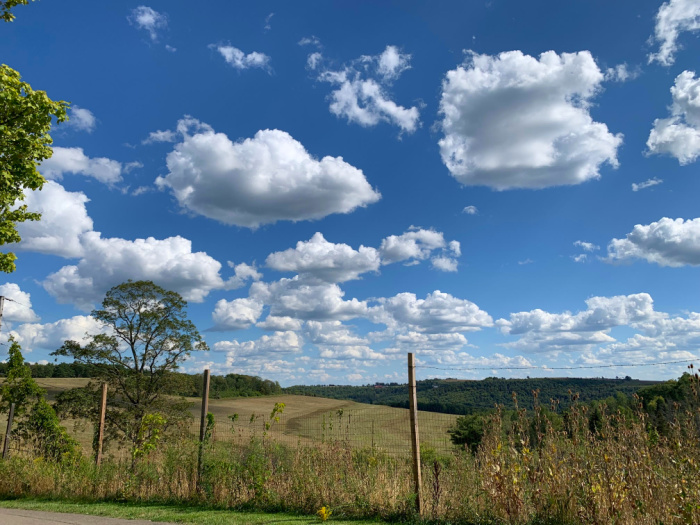
Photo… “Greetings Terry, I have been facilitating a Monastery of the Heart onsite group for nearly 14 years at Mount Saviour Monastery. In order to settle in to a slower pace than what I’ve left behind I have made it a practice to pause on arrival, look up and all around me and embrace the sight and sounds of nature and work and call to prayers there. I then do the same as I am leaving for home. Yesterday I could hear the sheep in the orchard as I paused to take in the sky and a mild and breezy day. In one photo you can see the mowed field where hay was harvested, in another a tractor in the parking lot waiting for the monk who paused in his work when the bells rang summoning all to the chapel for one of the Hours (prayers). Thank you for all you share,” Eve Davila (Southern Tier, NY)… Thank you Eve… and thank you for your photos, please send them to tdh@terryhershey.com