The gift of Home
A soldier’s young daughter (her father in the process of being transferred and moved to a distant post) sits on the floor in an airport departure lounge, among her family’s meager and ragtag belongings. Sleepy, the girl leans against the packs and lays her head on a duffel bag.
A well-dressed woman walking the concourse, stops when she sees the scene, and pats the little girl on the head. “Poor child,” the woman says. “You haven’t got a home.”
The child looks up in surprise. “But we do have a home ma’am,” she answers. “We just don’t have a house to put it in.”
Plato reminded us that “whatever is honored will be cultivated.” To put it another way, whatever we honor determines the way we “see” the world—it becomes our lens, or our paradigm.
This is a story about paradigms. The woman who stopped—even plausibly well intentioned—had a paradigm: home equals “stuff”. Or, in this case, big stuff, such as a house. (And, if we are honest, we must acknowledge that this is ingrained in all of us… it is our “American” paradigm.)
In her wisdom, the little girl in the story knew that home is not what we own, but who we are.
“It means a gradual process of coming home to where we belong and listening there to the voice, which desires our attention,” Henri Nouwen writes. “Home is the place where that first love dwells and speaks gently to us.”
Yes. And Amen.
This is the gift I received on my pilgrimage, walking the Camino de Santiago. I learned that my journey was not about “arrival”, or walking focused only on a “destination”, but the healing gift of reframing—and receiving—what it means to “be at home”. It was the invitation to open my eyes, to see, and embrace, the place where love dwells.
And I smile, remembering Laura Ingalls Wilder’s authenticity, “Home is the nicest word there is.”
So, let us begin here: This love Nouwen refers to, gives us a birthright gift of self. Every one of us—let me repeat, “every one of us”—arrives with our own gifted form, with the shape of our own sacred soul.
Parker Palmer observes, “Biblical faith calls it the image of God in which we are all created. Thomas Merton calls it true self. Quakers call it the inner light, or ‘that of God’ in every person. The humanist tradition calls it identity and integrity. No matter what you call it, it is a pearl of great price.”
It is true, there are many things that “take us away” from home—the feeling of “not being at home.” And not having a house isn’t among them. I’m thinking of things such as anger, busyness, self-importance, self-doubt, unforgiveness, despair, frenzied consumerism, and bitterness. It is seldom sudden.
And heartbreakingly, now in our world, too many among us are being told “you are not at home here, because you don’t belong here.”
But in every instance of disconnect, there is this reality—and it’s easy to see how this new weight becomes the definition for our identity (and of the identity, of every person who is dishonored).
And here’s the kicker: the above list requires that we focus on the periphery issues, on whatever is needed to impress, or use, or measure, or perform.
Bottom line? We end up focusing on what we don’t have.
Or even crazier, we focus on what we don’t have enough of. And it tells us who we are.
Even when we finally get what we are certain we “needed,” it turns out we needed more. Go figure.
In Sabbath Moment we often talk about the paradigms of sufficiency versus scarcity. And this we know; Scarcity is peddled in many ways… “More is always better.”
“That’s just the way it is.”
“Sorry, whatever you need, there isn’t enough.”
“If only you tried this…”
So, how can we move beyond the scarcity paradigm and dispel the illusion?
When Jesus reminded us that we are the “light of the world,” he didn’t add, “But only after you have your house in order.”
Sufficiency is the fuel, forming the ingredients and gifts that make up our home. And maybe, the “house” we put these gifts in, is not a building, but an encounter, a gesture, a conversation, a helping hand, a smile, or a hug.
My friends, the bottom line is this: carrying the little girl’s paradigm, we change—meaning that we choose to honor—what really “counts.” What a reminder (and gift) for the world in which we live.
Buckminster Fuller, he of geodesic dome fame, said that scarcity is about a “you-or-me world,” and sufficiency is about a “you-and-me world.” (Let us remember: We are on this journey together.)
I get it. If we begin with sufficiency, then perhaps what we “carry”—our home—is not stuff (or things or possessions) but rather opportunities.
Opportunities to be generous, big-hearted, kind, human.
Opportunities to be thoughtful, empathetic, and attentive.
Opportunities to offer hope. And yes, even if the gift we give (or the light that shines) comes from a wounded or broken heart.
I have an idea… This week let’s break the rules. The old rules demand that we obtain, consume, clutch, win at any cost—with no shame in hurting and demeaning others, and give only when it makes sense (or there is a payoff).
As a result, we see only what we want to see.
The little girl is right. We do have a home—full of gifts and a light that shines. A place that anchors us and sustains us. And also, a birthplace and incubator for creating space, offering sanctuary and affirmation and generosity for those who are left out. So. What houses (encounter, gift of generosity or healing, conversation, helping hand, smile, hug, and yes, saying “no” to cruelty) can we put “our home” in today?
And today was a gift for me. We visited Wimpole Gardens (a National Trust acreage near Cambridge), to wander gardens, and forests, and meadows. Including the permission to walk through the sheep meadows. So, yes, I had to stop for a wee bit. I do miss the time when I was able to preach to the sheep on Vashon Island.
I told the sheep here at Wimpole, that I was “impressed at how they reflected the spirit of serenity that being ‘home’ brings. And I want to thank you.”
“No worries, mate,” one said.
It made me smile real big.
Quote for our week…
Home (in my own skin), that “safe space to regain my bearings, reclaim my soul, heal my wounds, and return to the world as a wounded healer,” Parker Palmer writes. “It’s not merely about finding shelter from the storm—it’s about spiritual survival and the capacity to carry on.”
BULLETIN BOARD
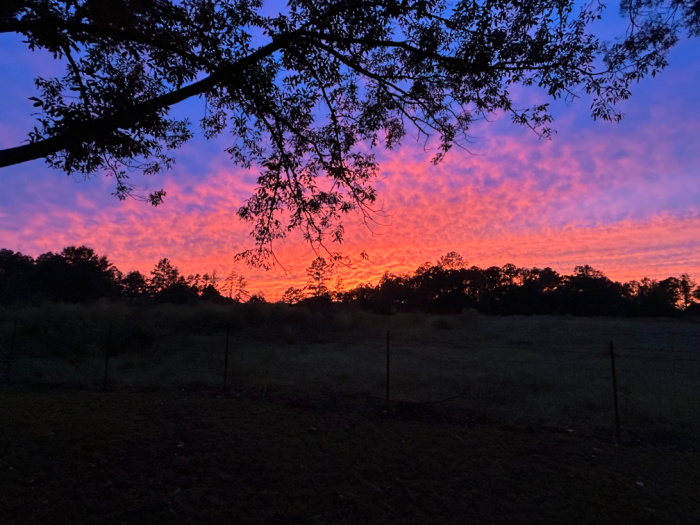
Today’s Photo Credit: “Hi Terry, I know you’re in England but just had to share these pictures my sister sent. They are in southern Alabama and waiting for hurricane Isaias to come ashore tomorrow. As she said, this sunset is the calm before the storm. So happy you’re getting to enjoy the beautiful UK and thankful we still get our Sabbath Moment every day.” Marge Austin… Thank you Marge… And thank you to all, I love your photos… please, keep sending them… send to tdh@terryhershey.com
POEMS AND PRAYERS
For the very earth is holy.
The ground under our feet.
Take off your shoes and feel it,
feel the dry-ground-powder
and the sharp stones,
the infinite tiny beings
that call the earth home.
Take off your shoes.
Know you are part of
all this, part of the
the glory that fills
all things, as the waters
fill the seas.
You will be heard,
wherever you are.
You can listen,
wherever you are.
You are home.
Andrea Skevington, “Holy Ground, barefoot”
Music for the Soul…
New–
Homeward Bound — Simon and Garfunkel