Daily Dose (February 24 – 27)

TUESDAY FEBRUARY 24 — It does my heart good when people stand up and say, “We get to say how the story ends.”
Which means that even in the darkness, we can be a place of light.
Let us never forget that no one of us can make it alone.
When life is “quanked”—on tilt or overpowered by fatigue—where do our marching orders come from?
Let us start here: Be kind, for everyone you meet is fighting a hard battle.
This I know: When we feel overwhelmed or drained, it is easy to miss—or not see—what is happening—places where light is being spilled. We miss small gifts of kindness and grace and mercy—even in the face of craziness or cruelty. Gifts that say, “Yes, kindness matters.”
I can tell you that I love to read—and to tell—stories about the power of kindness. Small gifts of kindness that make our world a better place. Gifts that replenish the receiver, and the giver. This is a story from 2018. It was in my stories file about the way we treat “the least of these”.
The headline in the newspaper: “Mexicans shower the caravan with kindness — and tarps, tortillas and medicine.”
Outside her family’s hardware store, Coqui Cortez, 57, set up a table to feed migrants (what we are calling the caravan) lemon tea and stew, using meat from her son’s butcher shop. Down the street, her daughter was handing out fruit.
“My family has been very blessed,” Cortez said. “And we know that we are all brothers. What God gives us, we should share. But we do it with a lot of love.”
For decades, because of poverty and violence, people have hiked the back roads and ridden trains heading north.
“Today it’s them. Tomorrow it could be us,” said Lesbia Cinco Ley, 70, who was volunteering with the Catholic church in town to distribute food.
So, get this. Town officials in Pijijiapan began readying for the caravan’s arrival, holding meetings to strategize how to attend to the migrants. Before dawn on Thursday, Cinco Ley and several others began cooking, on a mission to prepare giant vats of ham and eggs and 14,000 sandwiches. Between the municipality, churches and private citizens, town officials estimated Pijijiapan had spent nearly $8,000 for one day’s worth of food. “This is a poor town, but we still did all this,” said Guadalupe Rodriguez, 48, a city councilwoman.
(Adapted from Washington Post article, Joshua Partlow)
“And the law of kindness is on her tongue.” The Book of Proverbs
It is no surprise that I am frequently drawn to the story of the good Samaritan. I like Thomas Merton’s take, “Our job is to love others without stopping to inquire whether or not they are worthy. That is not our business and, in fact, it is nobody’s business. What we are asked to do is to love.”
I can choose to be a peacemaker. And a dispenser of kindness.
To all our friends in the northeast affected by the winter storm, stay safe, and be on the lookout for those who may need support or aid.
And a shoutout to all those I met in Anaheim at the Religious Education Congress.
I am so very grateful for the connections.
WEDNESDAY FEBRUARY 25 — When life is “quanked”—on tilt or overpowered by fatigue—where do our marching orders come from?
Let us start here: Be kind, for everyone you meet is fighting a hard battle.
And, that begins with sending some kindness inward. Care of any kind begins with self-care. Self-kindness.
I needed down-time today–for emotional hydration. I tell others to do this, but don’t always practice what I preach. So. I napped and read and rested. In my readings, this reflection from Maria Shriver did my heart good.
“Lent is an invitation to turn inward. It’s a chance to simplify things and to fast from something that has a quiet hold on you. It’s also an opportunity to create space for reflection. For prayer. For clarity. If I’m being honest, though, it’s also an invitation to examine myself. How do I speak about those in the headlines? How do I treat people I disagree with? Do I secretly delight in someone’s downfall? Do I rush to judgment? Do I participate in the very noise I say exhausts me?
Lent asks harder questions of me than what dessert I should give up. It asks me: Where has my heart hardened? Where am I withholding compassion? Where am I contributing to division rather than healing? This year, the physical things I’m giving up in my life are cookies and crackers. That may sound trite, but they are my daily go-to. My little comfort. My unconscious habit.
…Lent isn’t about deprivation. It’s about attention. It’s about noticing what quietly masters you. It’s about reclaiming your focus in a world that insists everything is urgent and everything is equal.
The words in Lizzie’s letter keep echoing in my mind: Nothing matters. And yet everything matters.
The avalanche matters. The Olympics matter. Abuse of power matters. Human suffering matters. Accountability matters. Truth matters. Compassion matters. But so does your inner life. So does how you pray and how you pause. So does how you respond to someone you disagree with, how you treat those you call your enemies, and how you speak about people when they are not in the room.
These forty days are a reminder that while everything clamors for our attention, we still get to decide what takes hold of us. We cannot fix every story. We cannot carry every outrage. We cannot absorb every headline. But we can choose who we are becoming in the midst of it all.
Regardless of whether you observe Lent, and regardless of whether you are Catholic, Jewish, Protestant, Muslim, Hindu, Buddhist, spiritual-but-not-sure-what-that-means, or simply someone trying to be a decent human being in complicated times… perhaps you, too, could take forty days to recenter yourself. Forty days to reflect on what truly matters to you. Forty days to fast from something that dulls you. Forty days to replenish your mind. To soften your heart. To steady your spirit.
Perhaps this is your invitation not to turn away from the world, but to turn inward long enough to remember who you are within it.
So give yourself forty days and forty nights. Give yourself space to be transformed. Space to transcend this current climate of noise and reaction. Space to return to that which truly matters. Space to examine your own heart before you judge another’s. Space to loosen what has quietly mastered you. Space to replenish your mind. To steady your spirit. To soften your edges. Space to remember that you are more than the headlines you consume. More than the outrage you scroll past. More than the fear that flickers across your screen.
May these days ground you. May they clarify things for you. May they strengthen what is generous in you and quiet what is reactive. May they remind you that you still get to choose what shapes you. Nothing matters. But everything matters.
So may you choose where you focus your attention wisely. May you choose with intention. May you choose with love. And may what you choose shape you into the kind of human being these times are calling for.
Remember, we are only here for a minute. It’s up to us how to make all those minutes matter.”
THURSDAY FEBRUARY 26 — This I do know: This week I really missed my old congregation, the sheep. I would preach to them every day on my walk, on Vashon Island.
And I remember a conversation I had with them a few years back, and how it did my heart good.
On my walk this morning, I stop, and stand at the fence. My congregation, the sheep, don’t mind silence, which is nice and different from many churches I have visited. After a while, I tell them, “I need your help. My heart hurts today, and I don’t know what to say. Or do. I know you all don’t read the news. But the world is broken. It’s been mentally and emotionally exhausting following updates.” They look up at me.
“You don’t mind if I stand here a little while, do you?” I ask. “It’s peaceful here.”
And I tell them about the heartbreaking news of the day. And then say, “I feel like I’m rambling. I’m sorry.”
“You sure do apologize a lot.” Their look tells me.
“Well, I grew up in a church that always required answers. And I don’t have any,” I tell them. “But I can tell you a story.”
A young girl who returns home from school in tears. Her mother worried, asked, “Sweetheart, what happened?”
“It was awful,” the girl told her Mother. “My best friend’s cat died. And she was very, very sad. And I don’t think I’m a good best friend, because I didn’t know the right words to say, to try to help her.”
“What did you do?” the mother asked. “I just held her hand and cried with her all day.”
“Thank you,” I tell my sheep congregation. “You did my heart good today. You helped me remember what matters.”
I tell them what Mother Teresa said, “If we have no peace, it is because we have forgotten that we belong to each other.” I think they liked it.
So. What do we do when our world feels upside down?
When our world feels unrecognizable and unsettled?
When we feel overwhelmed and alone?
I was schooled to know what to say. The “right” words, mostly for appearance. As if what I had to say, was more important than that I’m here. And I forget the power of simply being present.
When life is “quanked”—on tilt or overpowered by fatigue—where do our marching orders come from?
Let us start here: Be kind, for everyone you meet is fighting a hard battle.
I take heart when people stand up and say, “We get to say how the story ends.”
Which means that even in the darkness, we can be a place of light.
Let us never forget that no one of us can make it alone.
And for those who wish to watch my presentation, “Look for the helpers,” you can find it here on YouTube.
FRIDAY FEBRUARY 27 — In our world today—the news, the distractions, and the heartbreaks—can feel like “bombs” that overwhelm our spirit, and our energy. For many, a sadness permeates. It is no surprise many feel “quanked”—on tilt or overpowered by fatigue. Or exhausted, or disorientated or speechless.
And it is no surprise that many choose to keep their eyes down, telling themselves, “Don’t look.”
Here’s the deal: Life is precarious. And bombs are real.
So. How do we navigate? And what choices can we make?
In April 2015, a car packed with explosives detonated in the busy Mansour district of Baghdad, killing at least 10 people and injuring 27. After this incident, something very unusual happened. Karim Wasfi went to the bombsite, took out his cello, sat down on a chair amid ash and rubble in a black suit, his long hair combed back, and started to play.
Why go to the site of a car bomb to play your cello?
Wasfi, the renowned conductor of the Iraqi National Symphony Orchestra, said simply, “The other side chose to turn every element, every aspect of life into a battle and into a war zone. I chose to turn every corner of Iraq into a spot for civility, beauty and compassion. I wanted to show what beauty can be in the ugly face of car bombs, and to respect the souls of the fallen ones.”
We do know that when he played, soldiers cried. People kissed. They clapped, they felt alive, they felt human, and they felt appreciated and respected. This does not surprise me. When I watch the videos (Karim Wasfi: Combating Terror with Music), I cry too. Tears of solidarity and sadness and joy. Because gratefully, it touches something deep inside of me.
Here’s the deal: More than ever, I’m drawn to stories of everyday heroes, ambassadors for our collective soul. These stories are indispensable for wellbeing and an antidote to despair.
The bombs that go off around us take different forms… violence, natural disasters, loss of faith, cruelty, misinformation and deception, personal and emotional breakdown, fragile health. When it happens, it seems out of the blue. But it all adds up to wreckage. In our spirit. In our hearts. In our relationships. And when heaviness shifts the narrative, we feel at the mercy of, as if our power of choice is gone.
The good news? Jesus invites all who are weary and heavy laden. “Come to me, all you who are weary and burdened, and I will give you rest. Take my yoke upon you and learn from me, for I am gentle and humble in heart, and you will find rest for your souls. For my yoke is easy and my burden is light.” (Matthew 11:28-30)
A pause, and a place, where our soul can catch up to our body.
More than ever, I want us to live more consciously and compassionately.
Let me rephrase; more than ever, I want to live more consciously and compassionately.
Let us start here: Be kind, for everyone you meet is fighting a hard battle.
I take heart when people stand up and say, “We get to say how the story ends.”
Which means that even in the darkness, we can be a place of light.
Let us never forget that no one of us can make it alone.
So. “Here’s to the bridge-builders, the hand-holders, the light-bringers, those extraordinary souls wrapped in ordinary lives who quietly weave threads of humanity into an inhumane world. They are the unsung heroes in a world at war with itself. They are the whisperers of hope that peace is possible. Look for them in this present darkness. Light your candle with their flame. And then go. Build bridges. Hold hands. Bring light to a dark and desperate world. Be the hero you are looking for. Peace is possible. It begins with us.” L.R. Knost
Prayer (poem) for our week…
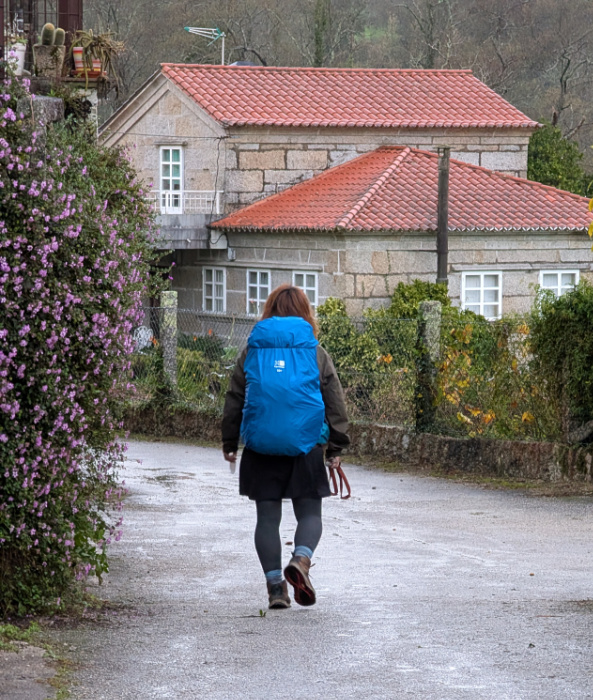
Walking Meditation
Take my hand.
We will walk.
We will only walk.
We will enjoy our walk
without thinking of arriving anywhere.
Walk peacefully.
Walk happily.
Our walk is a peace walk.
Our walk is a happiness walk.
Then we learn
that there is no peace walk;
that peace is the walk;
that there is no happiness walk;
that happiness is the walk.
We walk for ourselves.
We walk for everyone
always hand in hand.
Walk and touch peace every moment.
Walk and touch happiness every moment.
Each step brings a fresh breeze.
Each step makes a flower bloom under our feet.
Kiss the Earth with your feet.
Print on Earth your love and happiness.
Earth will be safe
when we feel in us enough safety.
Thich Nhat Hanh
Photo… “Dear Terry, A bit of brightness on a day earlier filled with rain. My thanks to you always,” Anne Carter Mahaffey (Oakland, CA)… Thank you Anne… And thank you for your photos, please send them to tdh@terryhershey.com
Donation = Love… Your gifts make Sabbath Moment possible.
I am so very grateful.
Please Share Sabbath Moment with others.
And find it on Facebook @RevTerryHershey