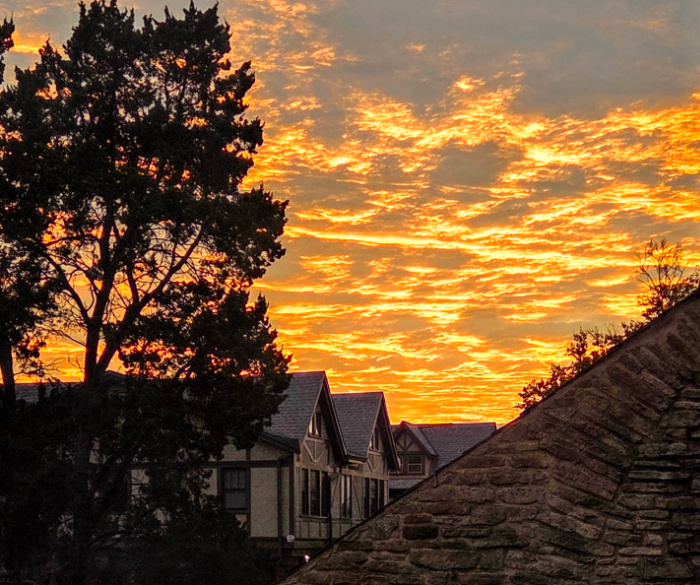
Daily Dose (September 29 – Oct 2)

TUESDAY SEPTEMBER 29 —
I once asked my analyst why I was in therapy. He told me it would make me a better gardener. Gardening can be strong medicine—an elixir that nurtures and shapes the soul. For that reason, it is a tonic seldom taken straight with no ice. Gardening has way of seeping into your soul, and one day you find yourself, in the words of poet May Sarton, spending the first half hour of the morning “enjoying the air and watching for miracles,” the joy and the light still alive.
Today Nancy and I enjoyed garden wandering in the Cotswolds. And the child in me, savoring the moments that make my heart come alive. With surprises, like so many flower blooms, varieties, and combinations all new to me.
Autumn is Dahlia heaven—now a plethora of colors and varieties. Maybe an extravaganza, or Fall pageant.
And fresh surprises. Blue Rock Bindweed, a soft and gentle blue. The exotic and charming white blooms on the Yucca plants. Meadow saffron, with wispy petals. And Everlasting flower (Straw flower), the flowers as if divinely chiseled. Their blooms continue to open as they dry, their yellow centers turning a beautiful, jewel-like golden color.
In the garden, I am viscerally aware of the replenishment vital to be fully present, and fully alive. In Hidcote Manor, there is a sign near a bench under an Italian Shelter that says, “Welcome to Hidcote’s Silent Space. We have partnered with the charity Silent Space to create an area of the garden where visitors are invited to take a moment to disconnect from the outside world and reconnect with nature.” Yes, and Amen.
A day that was heart-warming and heart touching. A wonderful reminder of our theme this week. We are hearts that touch.
Which may sound too sentimental in the real world, where hearts touch, and hearts hurt. In the real world, where hearts hope, and hearts break. Hearts heal, and hearts splinter. But here’s the good news: it is from those splintered places, that hearts give—love and empathy and healing and mercy—again, and again, and again. We are hearts that touch, and it makes our world a better place.
“What is REAL?” asked the Rabbit one day, when they were lying side by side near the nursery fender, before Nana came to tidy the room. “Does it mean having things that buzz inside you and a stick-out handle?”
“Real isn’t how you are made,” said the Skin Horse. “It’s a thing that happens to you. When a child loves you for a long, long time, not just to play with, but REALLY loves you, then you become Real.”
“Does it hurt?” asked the Rabbit.
“Sometimes,” said the Skin Horse, for he was always truthful. “When you are Real you don’t mind being hurt.”
“Does it happen all at once, like being wound up,” he asked, “or bit by bit?”
“It doesn’t happen all at once,” said the Skin Horse. “You become. It takes a long time. That’s why it doesn’t happen often to people who break easily, or have sharp edges, or who have to be carefully kept. Generally, by the time you are Real, most of your hair has been loved off, and your eyes drop out and you get loose in your joints and very shabby. But these things don’t matter at all, because once you are Real you can’t be ugly, except to people who don’t understand.”
“I suppose you are real?” said the Rabbit. And then he wished he had not said it, for he thought the Skin Horse might be sensitive. But the Skin Horse only smiled.
“The Boy’s Uncle made me Real,” he said. “That was a great many years ago; but once you are Real you can’t become unreal again. It lasts for always.”
“The Velveteen Rabbit”, Margery Williams
Thank you, my friends, for being a part of Sabbath Moment. I am grateful for the community. If you know anyone who would enjoy, and benefit from Sabbath Moment, please invite your friend to join us.
WEDNESDAY SEPTEMBER 30 —
We are hearts that touch.
Which may sound too sentimental in the real world, where hearts touch, and hearts hurt. In the real world, where hearts hope, and hearts break. Hearts heal, and hearts splinter. But here’s the good news: it is from those splintered places, that hearts give—love and empathy and healing and mercy—again, and again, and again. We are hearts that touch, and it makes our world a better place.
And here’s the deal my friends; when we ask one another, “How’s your heart?” it is an affirmation, and reminder, that self-care matters.
This we know: Care of any kind—compassion, generosity, forgiveness, reconciliation, peacemaking, service, ministry, teaching, giving, healing—begins with and is nourished by self-care. By self-compassion.
Care for our heart begins here: let us be gentle with ourselves. It is a restorative mainlined straight to the heart.
And if I practice what I preach (which I confess, is not always the case), you’ll find me out in the garden—and nature. The garden gives me permission.
To slow down.
To receive gifts of grace.
To be at home in my own skin.
I do love wandering gardens, drinking in the wisdom and gladness of late summer blossoms and colorations, which never say, “I’m just a flower.” They simply, and wonderfully, bloom.
This little light of mine…
And in Center for Action and Contemplation’s Daily yesterday, this life-giving affirmation from Thérèse of Lisieux. “Jesus set before me the book of nature; I understood how all the flowers [God] has created are beautiful, how the splendor of the rose and the whiteness of the lily do not take away the perfume of the little violet or the delightful simplicity of the daisy… If all flowers wanted to be roses, nature would lose her springtime beauty, and the fields would no longer be decked out with wildflowers. And so it is in the world of souls.” (Thérèse of Lisieux, “Story of a Soul”)
I’m not sure where the “garden”—nature, walking, reading, music, eucharist, meditation—is for you. But the invitation is life-giving. It’s okay to take care of yourself.
Be gentle with yourself. It is okay to ask for help. To not be perfect. To make mistakes. To not appease everyone. To say, “no”.
This is from Kent Neburn’s book, “Small Graces”. And it does my heart good… “I have walked a quiet path today… Do we really need much more than this? To honor the dawn. To visit a garden. To talk to a friend. To contemplate a cloud. To cherish a meal. To bow our heads before the mystery of the day. Are these not enough? If we should be so lucky as to touch the lives of many, so be it. But if our lot is no more than the setting of a table, or the tending of a garden, or showing a child a path in a wood, our lives are no less worthy.
To do justice. To love mercy. To walk humbly with our God.
To bring peace to the old. To have trust in our friends. To cherish the young. Sometimes, it seems, we ask too much. Sometimes we forget that the small graces are enough.”
Ahhh yes. This is the power of wonder. It is not just a reverie for my bliss. It is a grounding for my heart. And a grounding for mindfulness; the permission to pay attention to this life, and to the people who are in it, now available to greater depths of compassion and love. In other words, we see the people who make us better, and we see the people who have been wounded, depleted and diminished, who need compassion.
THURSDAY OCTOBER 1 —
Yesterday, I sat on a bench in Batsford Arboretum and Garden Centre (Gloucestershire, England) enjoying the sun on my skin, serenaded by the “music” the breeze inspires, as the limbs and the leaves dance.
I close my eyes, smile real big, and let the cares of the world (those that clamor and gnaw), gratefully recede.
And in my mind, I’m back to my university days, at the Abbey on the Isle of Iona, off Scotland’s northern shore.
In my mind compline has just begin. The breeze in the trees leads the chant, reminding me of the gift of enough. And the gift of wonder. The gift of my heart.
When compline “ends”, I replay the lines from a Mary Oliver’s poem.
“I don’t know exactly what a prayer is.
I do know how to pay attention, how to fall down
into the grass, how to kneel down in the grass,
how to be idle and blessed, how to stroll through the fields,
which is what I have been doing all day.
Tell me, what else should I have done?
Doesn’t everything die at last, and too soon?
Tell me, what is it you plan to do
with your one wild and precious life?”
“It’s a gift to yourself but it’s a gift to anybody who has a hunger for it,” Mary Oliver told Krista (Tippett) in a 2015.
The thought echoes something philosopher Simone Weil once said — that “attention is the rarest and purest form of generosity.” At a moment when the world can feel strange and difficult — or, at the very least, monotonous — Oliver’s poem draws our attention back to how our earthly existence may be just enough to get us through. She found inspiration in the works of the Roman poet Lucretius, whose Epicurean philosophy she sums up as: “What we are made of will make something else.”
“There is no nothingness — with these little atoms that run around too little for us to see. But, put together, they make something,” she said. “And that to me is a miracle. Where it came from, I don’t know. But it’s a miracle, and I think it’s enough to keep a person afloat.” If we understand existence as a miracle, then maybe the generosity that Simone Weil speaks of is not what we extend to others, but instead what the world offers us — if only we’re lucky enough to look up and around in awe. (Thank you, OnBeing Project)
From my time at Iona, I found grounding in Celtic Spirituality. And I carry with me each day the deep reverence for nature that is a central conviction in Celtic Spirituality. God’s presence permeates all of creation. Every single piece of it.
It is no surprise at all that wonder is our birthright. When our heart gratefully smiles big, and often laughs out loud.
But we forget that don’t we? “(Wonder) comes easily in childhood—the feeling of watching dust motes dancing in sunlight, or climbing a tree to touch the sky, or falling asleep thinking about where the universe ends. If we are safe and nurtured enough to develop our capacity to wonder, we start to wonder about the people in our lives, too—their thoughts and experiences, their pain and joy, their wants and needs. We begin to sense that they are to themselves as vast and complex as we are to ourselves, their inner world as infinite as our own. In other words, we are seeing them as our equal. We are gaining information about how to love them. Wonder is the wellspring for love… But you don’t have to be religious in order to open to wonder. You only have to reclaim a sliver of what you once knew as a child. If you remember how to wonder, then you already have what you need to learn how to love.” (Thank you Center for Action and Contemplation)
This is the power of wonder. It is not just a reverie for my bliss. It is a grounding, a mindfulness; the permission to pay attention to this life.
And, the permission to pay attention to the people who are in it, now available to greater depths of compassion and love. In other words, we see the people who make us better, and we see the people who have been wounded, depleted and diminished, who need compassion.
Which brings us back to our theme for the week: The heart is strong, and has capacity to give life.
After all, we are hearts that touch. Which may sound too sentimental in a real and fractured world; a world where hearts touch and hearts hurt, hearts hope and hearts break, hearts heal and hearts splinter… and; from those splintered places hearts that give again, and again.
An invitation to “pay homage with our presence, and what we fight for from the ground of what we love.” (Thank you Krista Tippett)
FRIDAY OCTOBER 2 —
Prayer (poem) for our week…
We do not become healers.
We came as healers. We are.
Some of us are still catching up to what we are.
We do not become storytellers.
We came as carriers of the stories
we and our ancestors actually lived. We are.
Some of us are still catching up to what we are.
We do not become artists. We came as artists. We are.
Some of us are still catching up to what we are.
We do not become writers… dancers… musicians… helpers… peacemakers.
We came as such. We are.
Some of us are still catching up to what we are.
We do not learn to love in this sense.
We came as Love. We are Love.
Some of us are still catching up to who we truly are.
Dr. Clarissa Pinkola Estes
Photo… “Good afternoon, I decided to take the Point Defiance Ferry (Tacoma) at Sunrise. Since God was having an Art exhibit I wanted to attend it. Thank you for your dedication to our journey home,” Marguerite Gerontis… Thank you Marguerite… And thank you all for your photos, please send them to tdh@terryhershey.com
Donation = Love… Your gifts make Sabbath Moment possible.
I am so very grateful.
Please Share Sabbath Moment with others.
And find it on our website terryhershey.com