Grace is alive
We are, every single one of us, wounded. That is a gift.
We are, every single one of us, broken. And that is a gift.
We are every single one of us, blessedly human, and no one of us is on this journey alone. That too, is a gift.
Yes, I know. It doesn’t always feel that way. I look, but don’t see any gift. Because I see brokenness and woundedness as impediments, or disabilities, to be tidied up, overcome, or prayed away.
What I don’t see, is the invitation to befriend my brokenness, and embrace the beauty and wonder.
I will admit that there is comfort donning my cape, morphing into Mr. Tidy OCD, an emotional life fix-it hero. And I know why. It distracts and protects me, because there’s a part of me that is afraid to pause, reluctant to befriend my scattered and wounded self. Afraid to let myself be loved for being this wonderfully messy, imperfect me. Grace, it turns out, is WD40 for the soul.
I remember a Far Side cartoon. Two women inside their house. Outside the closed front door (we see through the window) a giant hideous insect. Says one, “Calm down Edna, yes it’s one giant hideous insect, but it could be one giant hideous insect in need of help.”
We don’t see the gift, because we’ve been marinated in a narrative of scarcity (“I am not enough”). It is no surprise that we ascribe beauty to only the uncluttered, and success to only the strong or powerful.
My friends, here’s to the Power of Pause. You see, when we pause, and give ourselves the permission to hear the voice of grace (trusting our sufficiency), we are no longer afraid of the brokenness, or woundedness, or imperfections. Bottom line: they are not a threat to wholeness. In embracing our wounds, they become (as Richard Rohr reminds us) sacred wounds, because grace is alive and well.
So. It’s paradigm shift time. Time to move from a “project-management” view of life, to a “wade-in” view of life.
Life, in its brokenness, is not to be contained, explained or fixed. As if we recover and move on to “real life.” You know, the non-messy parts.
When we need to “move past” the life we have now, we miss the wonder, the beauty, and the tender purity, in what often feels like a cacophony.
We miss the sacrament of the present moment.
We miss that even in the sorrow, and the pain, and the unknowing, there is a whiff of the holy.
I am so grateful for this Sabbath time I’ve enjoyed here in England. And this week, I’ve been marinating in grace (a mixture of prayer, good vibes, blessings, and yes, virtual hugs). What a gift. It reminds me, incarnationally, that we do indeed walk one another home. And a reminder that befriending our woundedness is not a solo act.
And my confession: Marinating is not easy. Well, more candidly, it is not easy to be “embraced by the gift of grace”. What with our mind swirling about whether we deserve it, or whether we’ve done enough to earn it, or what will happen when our broken and unlikable parts become known.
And I am smiling about how we look at, see, and label “brokenness”. In the past two weeks, I’ve been in about 20 gardens—some public, some private, some National Trust gardens and arboretums—all life-giving, and all with a somewhat—well, even notable—different method of garden maintenance. We are here in Autumn, a garden season that kindles leaf-color-transformation. And in the perennial beds and borders, the dahlias are stunning, a contrast to the reminders that the blooms and foliage on many (well, most) of our best-loved flowering plants have come and gone. But I can tell you that my favorite gardens are those that do not remove the spent blooms on their perennial plants. I can hear in my mind the strict gardener voice, “Oh dear, you need to remove that unpleasant dead and brown part. It is unsightly.”
And I wish to tell them about how it does my heart good to celebrate, and say “thank you” to that “dead part” for the light it brought—and still brings—to our world. And the irony, that most often, the “dead part” is filled with seeds that will spill (and share), and make plants and gardens for the future.
Which brings us back to our theme. The gift of “brokenness”.
And to the connections we make when we share, remembering that no one of us is on this journey alone.
There was a farmer who grew excellent quality wheat and every season he won the award for the best grown in his county. One year a newspaper reporter interviewed the farmer, and learned that each Spring the man shared his seed with his neighbors, so that they too could plant it in their fields.
“How can you afford to share your best wheat seed with your neighbors when they are entering their crops in the competition with yours?” the reporter asked.
“Why that’s very simple,” the farmer explained. “The wind picks up pollen from the developing wheat and carries it from field to field. If my neighbors grow inferior wheat, cross-pollination will steadily degrade the quality of all the wheat, including mine. If I am to grow good wheat, I must help my neighbors grow good wheat.”
Amen. That’ll preach.
Here’s the deal: By planting and then sharing (spilling), we fight, and we resist contaminated “wheat” (shame, fear, small-mindedness, myopia, defensiveness, and callousness), with life-giving “wheat” (empathy, belonging, generosity, inclusion, reconciliation, and kindness).
From these places—sacred wounds—we speak truth, we do not need to pretend, or excuse.
We offer hope, we extend hands and hearts of compassion.
We see our connection with the lives of others around us, especially those broken or grieving or lost.
We see that they need a hand to hold. They need a voice. They need a sanctuary.
Whenever we love we are not alone. So, we wade-in, and stand in places of death and loss, and we find grace there. And if you see a hand that needs to be held today, please reach out.
For all of you in the leaf-changing parts of our world, savor the colors.
And for all of you who follow college football, enjoy the games. As a Michigan boy, I’ll lick my wounds while enjoying a pint in a British pub.
Gratefully, the weather here continues to impress, meaning the daily sun on our faces. And yes, another garden to visit.
Quote (Prayer) for our week —
The Blessing of Peace
Deep peace of the running wave to you.
Deep peace of the flowing air to you.
Deep peace of the quiet earth to you.
Deep peace of the shining stars to you.
Deep peace of the Son of Peace to you.
Ancient Celtic Prayer
BULLETIN BOARD
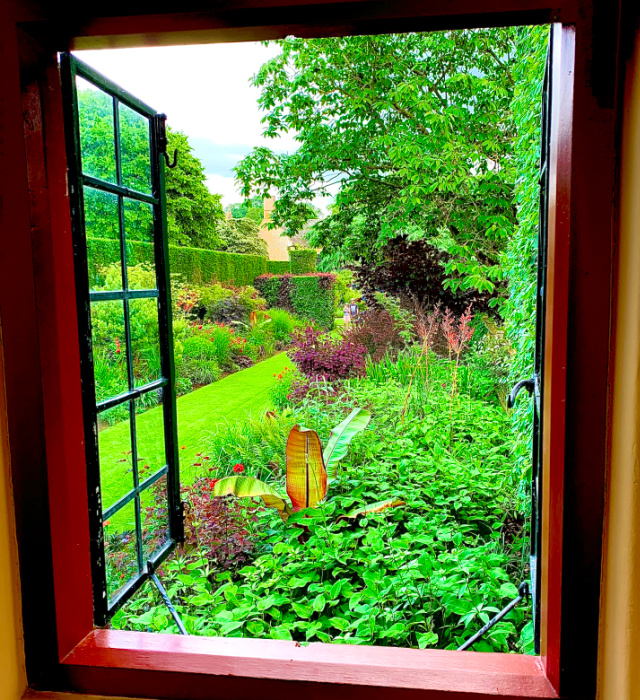
Today’s Photo Credit: “Dear Terry, Your Sabbath Moments calm my soul. Each day they remind me to live in the present, be kind and gentle to all, humans and creation, even on the days which fill with pains and disappointments and frustration. I am glad you were able to visit Hidcote Manor. I was there a few years ago. The beauty and diversity of the plants , flowers and trees were a balm of joy and peace. The surrounding country side in the Spring enthralled my senses. All the plant, bushes, and flowers diversity in and around the manor points to the truth of how unity in diversity creates beauty. I too sat in the Silent Space, so grateful that they had made room for it. Here are a few photos I took around Hidcote.” Sue Allen…
POEMS AND PRAYERS
Breathing Lessons
Let it in, let it all in
Let it all in to your heart
All that is, all that is gift
You don’t’ have to take it apart
Everything we do is like breathing
We’ve been holding our breath for too long
Could you trust your life to the seasons
and let the wind take you along
Let it out let it all out
Let it all out of your mind
Let it go, we don’t have to know
The answers to all that you find
There’s an emptiness that comes from having too much
Too much without any soul
Let out the lifeless the stale and the stuck
And let in what makes you more whole
Let in what makes you more whole
Charles Gaby
Music for the Soul…
New–
Be Still My Soul — Mount Royal Kantorei