Daily Dose (October 13 – 16)

TUESDAY OCTOBER 13 —
Two men visiting Hong Kong, noticed the ubiquity of street vendors, all pushing their carts along, pell-mell, in and out of traffic. Attempting to gain the attention of any potential customer, the vendors would shout repeatedly, “Sale! Sale! Good items for sale!”
So numerous were these vendors that the men found it difficult to avoid their aggressive sales pitches. It was then that they noticed a lone vendor, different from the others. This man stayed to himself, and slowly and quietly pushed his cart along the sidewalk. Intrigued, they stopped the vendor to ask him about his wares, “What are you selling?”
“Selling?” the vendor responded, “Oh, I’m not selling anything.” With that, he reached into his cart and picked up two pieces of a toy that had been broken. “You see, I buy broken things. My joy comes in mending. Once, mended, it can be given away, and bring more joy.”
This story does my heart good. Because there is a part of me that feels broken. And mending, well, that sounds very good to me. But I believe, in my mind (if I’m honest), that I am exchanging the word mending with the word, fixing. Somehow, I’ve persuaded myself that broken is a deficiency.
So. Let’s begin here: Some of us… no, all of us… break.
Maybe from stress or fatigue of spirit. Or from loss of childlikeness or grief. Or from loss of passion. Or from a world where cruelty and violence is too real.
Yes. Life is difficult.
And no matter how strong or safeguarded, very bad things can happen to good and innocent people. And sometimes I don’t have the words. Even for my prayers.
Here’s what I know: We live in a world where, more than ever, it is easy to lose our way—yes, to lose track of our heart. To feel derailed, disenfranchised, exasperated.
Or, just plain lost.
Bottom line, we are not at home.
And on those days, I wish I was made of stronger stuff. I don’t want to admit it, as it feels like a defect to be concealed.
Okay, I’ll personalize this; when I let the cacophony or noise win, I am not at home.
When either fear, or shame, win, I am not at home.
When I give way to any narrative of small-mindedness (where labels or differences are weaponized), I am not at home.
When I stay mute in the face of intolerance or contempt, I am not at home.
And we want someone to show us the way, or at least, the GPS coordinates.
Let us embrace Henri Nouwen’s invitation. “It means a gradual process of coming home to where we belong and listening there to the voice, which desires our attention. Home is the place where that first love dwells and speaks gently to us.”
Today, let us embrace the wisdom of the little girl in yesterday’s Sabbath Moment story. She knew that “home” is not what we own, home is who we are.
Here’s the deal: I have a choice. Brokenness can undo me. Or I can see an invitation to a bigger self, creating spaces for healing and spiritual hydration and renewal.
This is why I have always resonated with the Gospel story of the Good Samaritan. A man is laying in a ditch, having been beaten and left to die. Two pious men pass by, a priest and a Levite, seeing the man, but they continue to walk, without stopping.
The Samaritan stops. Why? Because he knew what it was like to be wounded too.
“He went to him and bandaged his wounds, pouring on oil and wine. Then he put the man on his own donkey, brought him to an inn and took care of him.” (Gospel of Luke)
You see, once we are open…
…to giving up our expectations and demands,
…to having our stereotypes contradicted,
…to embracing our brokenness,
…we find “There is a light in this world, a healing spirit more powerful than any darkness we may encounter.” (Mother Teresa)
When we see with our heart, we are grounded. We are conscious—present—no longer numbed. And tender hearts create sanctuaries for those left out. So, if ever there was a time for tender hearted, courageous men and women to step forward, it is now.
I like Thomas Merton’s take, “Our job is to love others without stopping to inquire whether or not they are worthy. That is not our business and, in fact, it is nobody’s business. What we are asked to do is to love.”
WEDNESDAY OCTOBER 14 —
Here in England, almost every day I walk by a pasture, or field, with sheep grazing. And I smile, remembering the days when I used to preach to the sheep on my walk.
After reading today’s news, I replay a conversation I had with them not long ago.
“I let my spirit get on edge,” I tell them. “There’s so much to do, my world is hungry for people to step up and embrace becoming bigger and better, including the discomfort that accompanies it, even if we don’t fully understand it yet. To give our hearts to creating a world, even if that is the small world around us; where sanctuary is real, where we say No to bigotry and hatred and cruelty. A world that honors dignity, and embraces the human, vulnerable, broken, passionate and redemptive self of anyone who crosses our path.”
“Did you practice that speech?” their look tells me. “That was pretty good. So, why are you still on edge?”
I smile. “You got any advice?
“Stay emotionally and spiritually hydrated.”
“Fair enough,” I say.
“And, a little joy and laughter wouldn’t hurt. You know it’s the superpower of resilience, and it’ll boost your immunity. Just because the world is overwhelmed, doesn’t mean you have to be.”
This makes me laugh. “This is why I like talking with you all.”
As I’m walking away, I hear one of the little ones say, “And don’t forget, more love, and more stories, wouldn’t hurt either.”
An elderly carpenter is eager to retire. He tells his employer (a very well-respected contractor) of his plans to leave the house-building business. He wishes to live a more leisurely life with his wife and extended family. He knows he will miss the paycheck, but it’s kick-back time and he needs to retire. And his family will get by. “I’ve hammered enough nails in one lifetime,” he tells his employer, with a laugh. There’s no need to put myself out any longer, he tells himself.
The contractor is very sorry to see his best carpenter go, and asks this, “Would you be willing to oversee the building of just one more house, as a personal favor to me?”
Hesitant, the carpenter says yes. In a short time, it becomes easy to see that his heart is not in his work. He resorts to substandard workmanship and uses inferior materials. It is an unfortunate way to end a dedicated career.
When the carpenter finishes his work the employer comes to inspect the house. The contractor hands the front door key to the carpenter.
“This is my gift to you,” he says. “This is your house.”
Most of us have been there. Holding those keys. And it never helps slip sliding down the if-only-stream. We know where that takes us.
In my memory I’m back in southern Michigan, the son of a brick mason. I’ve been on countless constructions sites. Most of them as a hod carrier (mixing mortar, lugging bricks). So many days eager to quit. And hearing my Father’s words, “Son, build this one like you’re building your own.” (Twenty-six years ago, my Father helped me build the house on Vashon Island.)
So yes. Let us remember; we make a difference with every nail we hammer, each board we choose, each brick we mortar, each window we put in place.
Because we live in a culture of bluster and ado, we forget that we can make a difference. And more often than not, the wrong people get the attention.
So. Here’s to the restorative power of small gestures… one nail at a time.
We are, all of us, builders. We are about the business of building places and spaces for human dignity and inclusion and justice and hope. For resilience and confidence and courage and safety and wellbeing.
But this is important. This parable is not meant to scold us into making a difference. It’s a recognition that we have been created and are able to do so. It’s not about bootstraps and will power and consternation. This is about letting the language of our (replenished and not overwhelmed) heart speak.
When I live from overwhelmed, I react, I live fearful, I give in to cynicism. No wonder the first to go are my courage and my ability to laugh. Which is not good considering that they both come from the same muscle in our heart.
THURSDAY OCTOBER 15 —
This week we are reminded that every one of us is a builder. We make a difference—with every encounter, every hand held, and hug given. We make a difference with every nail we hammer, each board we choose, each brick we mortar, each window we put in place.
I am the son of a brick mason. And I have a deep respect for the inspiring and beautiful stonework here in England—dry stone walls, houses, churches, cathedrals. All of them built hundreds of years ago. And let’s just say, on our pilgrimage here, we’ve spent a good bit of time, enjoying and admiring the stonework, with the history and stories that they tell.
It all resonates with my own history. It’s a story I have often told. I am the son of a brick mason. I am the eldest of five children. Which means that my summer options, as a schoolboy, were limited. I could be a hod carrier (mixing mortar—called “mud”—hauling bricks, blocks or stone and intuiting the needs of masons not known for their patience).
Or, I could be a hod carrier.
Being a hod carrier is real work. I mean, physical work. Dog-tired at the end of the day work. And I couldn’t wait to grow up and go to college, and get a real job.
My father’s leadership style, typical of Midwestern fathers of his generation, was straightforward, “Don’t loaf. Don’t whine. Don’t make excuses. This’ll make a man out of you.” (I will admit, as a high school football player and wrestler, I couldn’t have asked for a better workout regimen.)
Even so, college beckoned. Real work, you know, where I could make a real difference. And become somebody.
And I did. After two degrees and an ordination, I set out as The Reverend. No longer just a hod carrier, or just a construction worker.
On one visit to Michigan in my late 30s, my father and I drove the streets in the small town of Sturgis, drifting in his pickup truck. We could drive for miles without saying much. (Not a bad skill to learn.) The truck slowed as if by volition, and I wondered if something was amiss. Then it hit me. My Father slowed to regard a house that he had built; decades prior. He parked by the curb. And he told me stories, about building the house, about the owner, about members of the crew and about pranks played on the job site.
For the rest of the afternoon, we meander the streets, looking not just at houses or chimneys, but also at the quality of work that has stood the test of time. These weren’t just buildings. They were works of art and labors of love.
And then we stopped in front of a house I recognized. Where I spent a summer on a crew, just a hod carrier, building someone’s dream. (But I hadn’t seen it.)
And the light bulb came on.
Now, I never use the phrase “just a” anymore. About anyone.
I know this for certain: it doesn’t take much to nurse resentment or regret. There are times when whatever we are doing seems not enough (no doubt a miasma of guilt or shame and the vagaries of public opinion).
Over the years I have heard, “I’m just a volunteer (or just a member, or catechist, or teacher, or aid, or worker, or helper, or employee, or friend, or mother or father or fill in the blank).”
To each I say, No.
You see, “just a” creates a label and tells us what we are not. And when we label, we dismiss. (Regardless of the label. Dorothy Day once scoffed, “Don’t call me a saint. I don’t want to be dismissed so easily.”)
So, how then do we make a difference?
Here’s the deal: Your work (labor) is your turf of responsibility. Which is only part of our DNA. Because no matter where we labor or toil, our calling is to spill the light.
And the good news? For this we don’t have to pass a test, or qualify, we have only to be willing.
Jesus made it simple, “Let your light shine.”
Not, when you get your act together.
Not, when you feel noble.
Not, when you find a specific vocation.
Not, after you’ve chased all the gloom away.
Just let it shine. Because the light is already there. Inside of you. Now.
What we do—how we “choose”—and who we are, touches lives, plain and simple.
This matters more than ever, in a divisive world, a world on edge, a world where a kind word or gesture makes all the difference. We need a reset on making a difference.
My Father never signed a contract. His handshake was his word. One man told me, “When Jerry Hershey shook your hand you knew you were going to get something you would be proud of. Something that would stand the test of time.”
What did my Father build? Houses.
What did my Father do? He made a difference.
My Father died in 2020. RIP dad.
Because we live in a culture of bluster and ado, we forget that we can make a difference. And more often than not, the wrong people get the attention.
So. Here’s to the restorative power of small gestures.
FRIDAY OCTOBER 16 —
I am writing this Sabbath Moment, sipping my coffee, in a “house” (a building), that became a “home” (a dwelling for stories and relations), in the small village of Duxford, UK (near Cambridge).
In 1793, Benjamin Pyne, a “probationer” Minister with the Methodist Church, purchased the land. It was his vision to build a chapel, and a manse.
The construction of the chapel, which cost all of 396 pounds (yes, you can pause and smile at what looks like a typo) commenced the following year. It was a community endeavor, and the local farmers gave of their time and energy, hauling (free of charge) bricks, tiles, stones and windows mostly from nearby Horseheath.
The chapel was completed in the summer of 1794. And the locals gathered for worship for the first time, on August 3rd.
The Church was officially constituted in November, 1794. The following month Mr. Pyne, just aged 27, was ordained. Mr. Pyne ministered at the church, and in the community, until he fell ill in 1831.
In the years that followed, the church continued to grow and minister to the community, which at one time in their history showed a “directory” of up to 750 congregants.
The chapel continued to be a faithful witness in the village throughout the 19th and 20th centuries. After significant damages in WWII, the building was not only a place for worship, but slowly brought into other community uses, which included serving as the village Post Office. In the years that followed, the congregation grew smaller, and the momentous decision was made to close the Chapel in 2019.
The building was converted into two mezzanine apartments. And gratefully, it intentionally maintains much of the feel of the church, including the windows (and the light that spills through, as I write these words, not far from where the pulpit would have been). And I raise my cup to Rev. Pyne. I am grateful and moved, to be in places and spaces, that hold stories of how people created communities where they bonded to make our world a place of sanctuary and friendship and healing.
(For this history, thank you to Matt Carter.)
Two observations come to mind. The first is the gift that comes when we embrace the wisdom of the little girl in Monday’s Sabbath Moment story. She knew that “home” is not what we own (meaning the building itself), home is who we are—and the offerings of kind-heartedness and compassion we bring.
And I remember this affirmation at the funeral of Pope Francis.
“He (Pope Francis) often used the image of the Church as a ‘field hospital’ after a battle in which many were wounded; a Church determined to take care of the problems of people and the great anxieties that tear the contemporary world apart; a Church capable of bending down to every person, regardless of their beliefs or condition, and healing their wounds.” Cardinal Re said in the funeral homily.
Yes, and Amen. Francis, a voice of mercy, for the wounded and the marginalized—inviting the compassionate treatment of those in need, and yes, the gift of “home” and grounding (even and especially when it’s within one’s power to harm or “punish” them).
And this I know my friends: We live in an emotionally and spiritually de-hydrated world, thirsty for the sustaining balm of mercy—as builders of healing places and “repairers of our world.”
Because we live in a culture of bluster and ado, we forget that we can make a difference. And more often than not, the wrong people get the attention.
So. Here’s to the restorative power of small gestures.
And this from SM reader Mary Louise, “Terry, your carpenter story reminds me of one of my father’s favorite poems.”
“Princes & Kings
Isn’t it strange how princes and kings,
and clowns that caper in sawdust rings,
and common people, like you and me,
are builders for eternity?
Each is given a list of rules;
a shapeless mass; a bag of tools.
And each must fashion, ere life is flown,
A stumbling block, or a Stepping-Stone.”
(R. Lee Sharpe)
Prayer (poem) for our week…
After the good earth
where the body knows itself to be real
and the mad flight
where it gives itself to the world,
we give ourselves to the rhythm of love
leaving the breath
to know its way home.
And after the first pure fall,
the last letting go, and the calm
breath where we go to rest,
we’ll return again to find it
and feel again the body welcomed,
the body held,
the strong arms of the world,
the water, the waking at dawn
and the thankful, almost forgotten,
curling to sleep with the dark.
The old wild place beyond all shame.
David Whyte
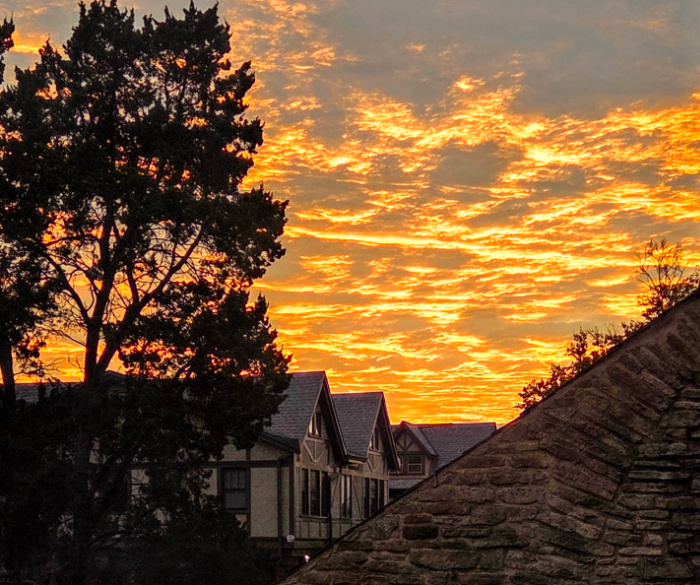
Photo… “Hi Terry, The unbearable heat in San Diego this past week brought beautiful sunsets as well, as seen from my backyard. Enjoy your weekend!” Kathy Frost (San Diego, CA)… Thank you Kathy… And thank you all for your photos, please send them to tdh@terryhershey.com
Donation = Love… Your gifts make Sabbath Moment possible.
I am so very grateful.
Please Share Sabbath Moment with others.
And find it on our website terryhershey.com