Treasury of Grace
I am so grateful for the power of pilgrimage. The healing and restorative gift of the journey (the lessons we absorb along the way, as we pay attention like never before, and yes, the health benefits for a middle-age—okay, upper middle-age—body). And grateful for the permission to focus on being drawn to sacred sites and spaces.
I continue to marvel at the spillage from my pilgrimage on the Camino de Santiago, and now see all of my “travels” through a different lens.
We spent yesterday in Canterbury. And much of the day in, and around, the Cathedral. It has been a place of worship for over 1400 years. And a center of pilgrimage for centuries. And yes, the inspiration for stories—literature, poetry, drama, and homily.
“During the Middle Ages, the cathedral was one of the most important centers of pilgrimage, rivaling Rome and Compostela. Arriving at Canterbury, the pilgrims made their way up the steps in the quire (choir) aisles, the stone worn by the feet and knees of countless worshippers, and around the horseshoe-shaped ambulatory (the space that allows clergy, choirs, or pilgrims to walk continuously around the apse or main altar without disrupting services).” (Thank you, Canterbury Cathedral.)
In Chaucer’s “Canterbury Tales”, 30 pilgrims began their pilgrimage toward Canterbury. And if you’ve read the “Tales” (I remember writing a paper on it in college), you know the journey inspired yarns, lampoons, parables and stories.
“Medieval folks always did love a good pilgrimage. Grueling journeys had a way of proving the mettle of heroes, and far-flung reliquaries held forth a treasury of grace to any commoner willing to tread the pilgrim way.” (Chad Ashby)
Yes, I read and wrote about “other” folk, but curiously, never once considered myself as a “pilgrim”.
Granted, all of us may not be headed toward Canterbury, but we are, each and every one of us, on a pilgrim’s way. Even as we go about the doings of our “very ordinary” day. I may have preached such earlier in my life, but until I walked the Camino, I didn’t appreciate and welcome the power of “investment” in the sacrament of each moment, of each day—welcoming the gifts of spiritual renewal, renewed focus, new communal connections, and yes, physical rejuvenation.
So. On my “pilgrimage”, what have I learned, or absorbed, today?
Where have I found places (“treasuries”) of grace, and restitution?
What changes (and confessions) am I choosing to make?
We are, every one of us, on a daily pilgrimage. It is my prayer that Sabbath Moment accompanies (and sustains) us with stories along the way. Invitations to look for places that heal you, and places that inspires you. These are the places we need to go often.
When people talk about pilgrimage, they often refer to them as a “bucket list walk”.
That makes me smile. And I’ll say this; a bucket list for me, is spending time in places that heal and replenish.
Here’s the deal: Care of any kind begins with self-care.
We too easily don’t see or make the connection. We see shifts and threats to our life and our world, and then we set out, mentally and emotionally and behaviorally, to make changes, as if we need to find “the precise script”. Wondering, where should we be (instead of where we are)?
Forgetting that even when life is catawampus, our choices—to care and give and make a difference—spill from our replenished self. From that replenished place we can see, listen, relinquish assumptions, and choose to make the world—our small world that we touch—a safe, compassionate, inclusive, empathetic, kindhearted, healing place.
Relative to replenishment self-care, I have always found this helpful. When the Shawnee and Chippewa (and other early people) went on hunts or vision quests or long journeys, each traveler would carry in a small rawhide pouch, various tokens of spiritual power—perhaps a feather, a bit of fur, a claw, a carved root, a pinch of tobacco, a pebble or a shell. These were not simply magical charms; they were reminders of the energies that sustain all of life. By gathering these talismans into a medicine pouch, the hunter, traveler, or visionary seeker was recollecting the sources of healing and bounty and beauty. (Adapted from Scott Russell Sanders, “Hunting for Hope”)
I do know this; if my medicine pouch is filled with a need for control and answers (for closure), I can easily be seized with fear, panic, rage, despair, depression, exasperation and frustration. (You get the picture?)
But what if? What if the “tokens” in that pouch are not a magic wand to undo life, but instead, the power and the freedom to embrace the life we have been given. And to see in this life, this day, even in the very muddle of the ordinary, even in the very chaos of the ordinary gone awry, the permission to experience a whiff of the holy.
That God is not waiting until we have it all figured out.
The gift of life is in this present moment.
Yes. That’s it. We can choose. This is an invitation to participate—and invest—in this life. To bring all that I am to the table of this moment.
To invest my heart.
To be a witness for integrity and justice.
To create space for healing and restitution.
To spill light where I can.
What Barbara Kingsolver calls a “conspiracy with life.”
Easy? No. Somedays, I feel very broken. Broken and dispirited. And I don’t have the words. And I don’t have the strength. Maybe you can relate.
So, how can we be a witness then? What possible difference can we make?
Well, this is interesting. You see, compassion (service and care) and healing (restoration) are not mutually exclusive. Because the light we share is born in those broken places. Which means that being a witness goes hand in glove with renewal.
In other words, we find replenishment and we choose to be a witness.
This is not a pep talk. This is not a test to pass. Or a list I check off for God’s thumbs up. This is permission; the invitation and the affirmation to be, and to live, wholeheartedly and kindheartedly, the truth of who I am.
Please know this my friends: it is from this self—the broken or wounded self—that compassion and kindness and tenderness and empathy and healing and reconciliation can flow.
I am writing this in Herne Bay, looking out of my window, onto the shoreline of the Thames Estuary, connected to the North Sea, on a very blustery, and stormy day, the waves roiling and pounding. Let’s just say, I am very grateful for a safe and dry place to watch the theater drama.
Quote for our week…
As we go in to the weekend, let us take with us this prayer from St. Therese of Lisieux (“the Little Flower”).
“May today there be peace within.
May you trust God that you are exactly where you are meant to be.
May you not forget the infinite possibilities that are born of faith.
May you use those gifts that you have received,
and pass on the love that has been given to you.
May you be content knowing you are a child of God.
Let this presence settle into your bones,
and allow your soul the freedom to sing, dance, praise and love.
It is there for each and every one of us.”
BULLETIN BOARD
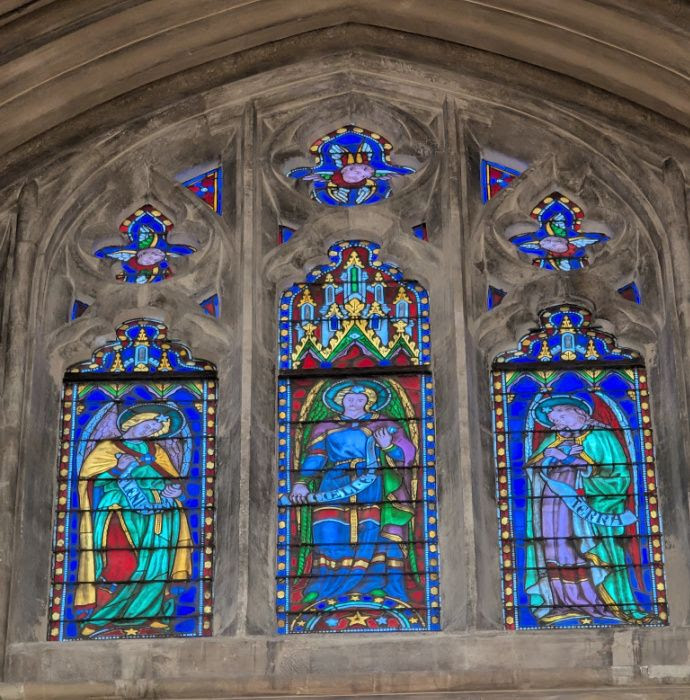
Today’s Photo Credit: One of the stained glass windows in Canterbury Cathedral (Canterbury, England). There are dozens of them some containing the oldest surviving stained glass in England. And all of them, telling a story… Thank you Marge… And thank you to all, I love your photos… please, keep sending them… send to tdh@terryhershey.com
POEMS AND PRAYERS
Late Autumn Garden
When I travel
I look for public gardens to visit
“But this is almost winter,”
a docent tells me
“There is not much to see here now.”
As it is
in my own garden.
Except in the early morning light
when outside my study window
I behold a still-life, in sepia tones.
Our lawn encrusted with hoarfrost
now a veil, silver glazed.
Gilded for a commemoration
I am certain,
as I walk under an ice-blue-sky
and listen to my breathing
and hear the crunch under foot.
Stillness is not just a word
in a winter garden.
It is a space,
a place where the air drapes,
literally.
As if there is nothing pressing,
nothing to decide,
nothing to accomplish,
except to wait. And rest.
The Clematis, with vines now browned and brittle,
–from life given as an prodigal summer offering–
covers our arbor
co-mingling with canes of Old Garden Roses
still defiantly nurturing the remnants of old blooms
while perennials have deferred to the weather,
and lay strewn upon the ground,
now a carpet of aftermath–a new year parade’s exhausted gift.
And I smile, and ask myself, “So what is next
on this winter day,
when there is not much to see?”
Terry Hershey
Music for the Soul…
New–
A Pilgrim’s Prayer — Rich Dawson